
How to Stain Your Driveway Without Losing Your Mind
How to Stain Your Driveway Without Losing Your Mind
Patio concrete stain is one of the most effective ways to transform a dull, worn concrete surface into a durable, attractive outdoor space — without tearing it out and starting over.
Here’s a quick look at what you need to know:
| Question | Quick Answer |
|---|---|
| Best stain types for patios | Acid-based (earthy tones, permanent) or water-based (wider colors, easier application) |
| Can you stain existing concrete? | Yes, if the surface has no major spalling or cracks |
| Do you need a sealer? | Always — sealer protects color and adds durability |
| DIY or professional? | DIY is possible, but pros deliver longer-lasting results |
| How long does it last? | Years with proper sealing and maintenance |
Plain gray concrete doesn’t have to stay plain. Staining penetrates into the concrete itself — it doesn’t just sit on top like paint. That means it won’t peel, flake, or chip the way painted surfaces eventually do.
The results can be striking. A flat, lifeless patio can become a rich, multi-toned surface that looks like it belongs in a magazine. And it adds real value to your home.
But here’s the catch: the process matters as much as the product. Poor prep work is the number-one reason staining jobs fail — and that’s true whether you’re in Georgia’s humid summers or anywhere else with weather extremes.
I’m Scott Shannon, owner of Creative Concrete Coatings and a Marine Corps veteran with decades of hands-on experience applying patio concrete stain across residential and commercial properties throughout Georgia. In this guide, I’ll walk you through exactly how to get it right.
Choosing the Right Patio Concrete Stain for Your Climate
In regions like Monroe, GA, and the surrounding areas from Suwanee to Athens, our concrete has to survive intense UV rays, high humidity, and the occasional winter freeze. Picking the right patio concrete stain isn’t just about the color; it’s about how that color interacts with the concrete’s chemistry, a process often studied by the American Concrete Institute.
When we talk about staining, we usually divide products into two main camps: acid-based and water-based. Both have their place, but they behave very differently once they hit the slab.
| Feature | Acid-Based Stain | Water-Based Stain |
|---|---|---|
| Composition | Mineral salts, water, and mild acid | Pigments and acrylic polymers |
| Reaction | Chemically reacts with concrete minerals | Penetrates pores (non-reactive) |
| Color Range | Earth tones (tans, browns, terracotta) | Wide spectrum (vibrant to subtle) |
| Appearance | Variegated, mottled, translucent | More uniform, semi-transparent |
| UV Resistance | Excellent (permanent) | High (if high-quality pigments are used) |
Acid-Based Stains: The “Mad Scientist” Approach
Acid stains are “reactive.” They contain mineral salts that react with the calcium hydroxide in the concrete. This creates a permanent chemical bond. If you want a patio that looks like weathered stone or aged leather, this is your go-to. Because the reaction depends on the concrete’s unique mineral makeup, no two patios will ever look exactly the same. It’s a bit unpredictable, which is exactly why people love it.
Water-Based Stains: The “Artist’s” Choice
Water-based stains are “non-reactive.” Think of them more like a very thin, translucent ink that fills the pores of the concrete. They offer a much broader palette. If you’re looking for a specific shade of blue or a solid contemporary gray, water-based options provide more control. These are generally easier for DIYers to handle because there’s no hazardous acid to neutralize afterward.
For those looking for the ultimate durability, Choosing the Best Outdoor Concrete Coatings for Durable, Beautiful Patios in Monroe, GA is a great resource to help you decide which path fits your specific backyard goals.
Essential Preparation: Can You Stain Existing Concrete?
The short answer is: Yes, but only if the concrete is “thirsty.”
If you pour a glass of water on your patio and it beads up, you have a problem. That means there is an old sealer, wax, or heavy grease preventing anything from soaking in. To get a patio concrete stain to take, we have to open those pores.
The “Clean and Mean” Checklist
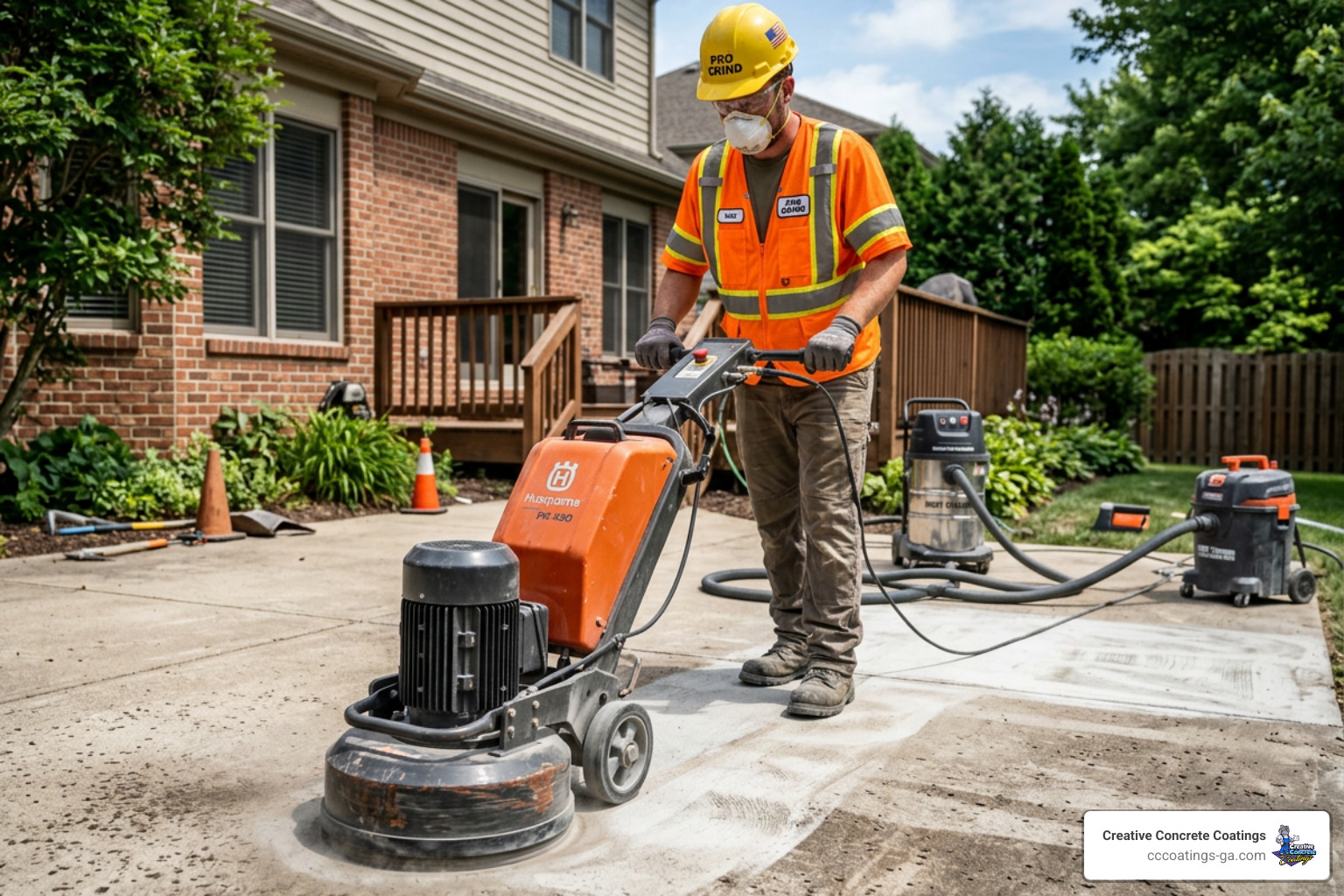
Before we even think about color, we have to look at who’s restoring the slab. If you’re wondering Who Restores Old Concrete Patios and Slabs in Monroe, GA?, you’ll find that professionals (like us!) often spend 75% of the project time on prep.
- Degreasing: If you’ve spent years grilling on that patio, there’s likely grease deep in the pores. Standard soap won’t cut it; you need a heavy-duty degreasing agent.
- Stripping: If the patio was sealed five years ago, that old film must be completely removed. We use mechanical grinding or chemical strippers to get back to the raw “white” concrete.
- Mechanical Grinding vs. Acid Etching: For the best bond, we prefer mechanical grinding. It uses diamond-topped blades to “profile” the concrete, creating a surface that feels like fine sandpaper. If grinding isn’t an option, acid etching can work, but it must be done carefully to avoid damaging the slab.
- Moisture Testing: Concrete is like a sponge. If there’s too much moisture coming up from the ground, the stain or sealer might fail. We always check the moisture levels before proceeding.
- Crack Repair: Stains are translucent. They will not hide cracks. In fact, they often highlight them. We fill cracks with specialized epoxy or mortar and grind them flush so they disappear under the new finish.
Step-by-Step Guide to Applying Your Stain
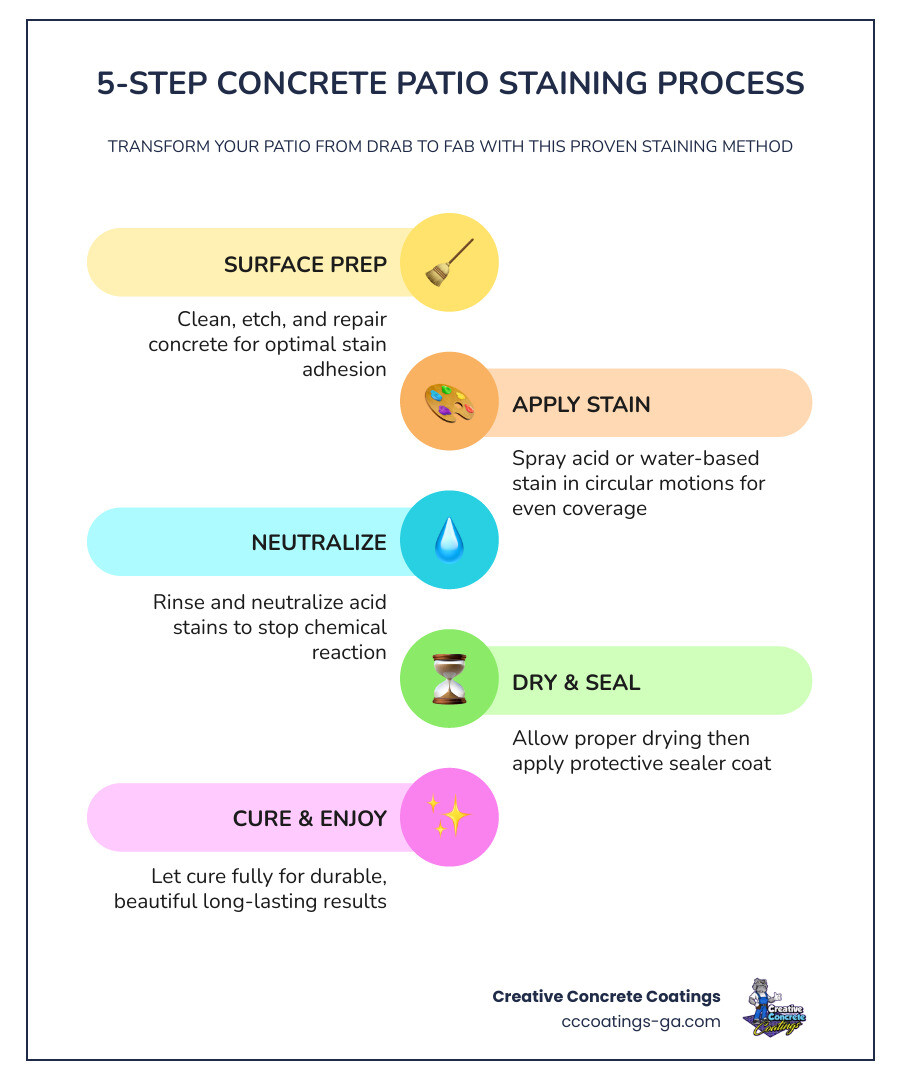
Once the surface is prepped and bone-dry, it’s time for the fun part. But don’t just dump the bucket and hope for the best.
- Masking: Stain goes everywhere. Use plastic sheeting and painter’s tape to protect your siding, sliding doors, and landscaping.
- The First Coat: We typically use a high-quality pump sprayer. The trick is to keep a “wet edge” and move in circular, overlapping motions. This prevents “lap lines”—those ugly dark stripes where the stain overlapped and dried too quickly.
- Saturation Levels: Don’t let the stain puddle. If it pools in a low spot, it will dry much darker than the rest of the patio. We often have a second person “back-roll” the stain with a 3/8-inch nap roller to ensure even distribution.
- Drying Windows: Most stains need at least 4 to 8 hours to dry. Water-based stains may take up to 24 hours to fully cure before they can be sealed.
- Neutralizing (Acid Stain Only): If you used an acid stain, you must neutralize it with a mixture of water and baking soda (or a professional neutralizer). If you skip this, the acid will keep eating the concrete and your sealer will eventually peel off.
Achieving Professional Results with Patio Concrete Stain
To move from “decent DIY” to “professional masterpiece,” we use a few trade secrets.
- Secondary Color Layering: After the base coat is dry, we often mist a second, darker color over the top. This adds “depth” and mimics the look of natural stone.
- Edge Detailing: We use small brushes or handheld sprayers for the edges to ensure the color is consistent right up to the house.
- Decorative Saw-Cuts: Want the look of expensive tile? We can use a circular saw with a diamond blade to cut shallow “kerfs” into the concrete in a diamond or square pattern. When we stain the “tiles” different colors, the result is stunning.
Maintenance and Sealing for Long-Lasting Beauty
Stain provides the color, but the sealer provides the “soul” and the protection. Without a sealer, your patio concrete stain will fade under the Georgia sun in just a few seasons.
The Power of the Sealer
We recommend solvent-based acrylic sealers for outdoor patios. They offer the best UV protection and create that “wet look” that makes the colors pop.
- UV Protection: Our Georgia sun is brutal. A high-quality sealer acts like sunscreen for your patio.
- Slip Resistance: Stained and sealed concrete can be slippery when wet. We always mix in a slip-resistant additive—a fine, clear grit—into the final coat of sealer to ensure your pool deck or patio is safe for the kids.
- Water Beading: You’ll know your sealer is working when rain beads up on the surface like it’s on a freshly waxed car.
Keeping it Clean
Maintenance is surprisingly easy.
- Regular Sweeping: Keep sand and grit off the surface; they act like sandpaper under your shoes.
- Mild Detergents: Use a pH-neutral cleaner or a simple mix of dish soap and water. Avoid harsh chemicals or “orange” cleaners that can break down the sealer.
- Resealing Schedule: Depending on foot traffic and sun exposure, plan to apply a fresh “refresh” coat of sealer every 2 to 3 years.
Frequently Asked Questions about Patio Concrete Stain
Is patio concrete stain better than paint?
Yes, hands down. Paint forms a film on top of the concrete. Because concrete is porous and “breathes,” moisture from the ground gets trapped under the paint, causing it to bubble and peel. Patio concrete stain penetrates the surface. It allows the concrete to breathe while providing a color that won’t flake off.
How long does a patio concrete stain last?
If the sealer is maintained, the stain itself can last for decades. The sealer is the sacrificial layer. As long as you don’t let the sealer wear completely away, the color underneath remains protected and vibrant. In high-traffic areas like a driveway or a busy pool deck, you might need to touch up the sealer more often, but the color is permanent.
Can I stain a patio myself or should I hire a pro?
You certainly can DIY a small patio, but for large areas or complex designs, the stakes are high. One mistake with an acid stain can be permanent. At Creative Concrete Coatings, we bring 25+ years of experience to every job. We have the professional-grade grinders to prep the floor properly and the expertise to handle the humidity swings we see in Dacula, Loganville, and Johns Creek.
If you’re looking for a finish that is guaranteed to last, checking out What’s the Best Company for Outdoor Concrete Coatings in Monroe, GA? will lead you right to our door. We’ve installed over 455,000 square feet of coatings, and we stand by our 100% satisfaction guarantee.
Conclusion
Transforming your outdoor space doesn’t require a jackhammer. With the right patio concrete stain, you can turn a boring slab into a high-end feature that boosts your property value and makes your backyard the envy of the neighborhood. Whether you want the earthy, organic look of an acid stain or the vibrant, controlled tones of a water-based system, the key is in the preparation and the protection.
Ready to stop looking at that gray slab and start enjoying a designer outdoor space? Transform your outdoor space with Creative Concrete Coatings and let our team of experts handle the heavy lifting. From Monroe to Alpharetta and everywhere in between, we’re here to make sure your concrete looks its absolute best.