Stop the Peel with the Best Outdoor Driveway Paint
Beyond the Brush: Why High-Performance Coatings Outlast Driveway Paint and Sealer
When you walk into a big-box hardware store in Suwanee or Alpharetta, you are greeted by rows of colorful cans labeled “driveway paint.” It’s tempting to think a quick coat of paint is all you need to spruce up your curb appeal. However, there is a massive difference between a topical driveway paint and sealer and a high-performance industrial coating.
Standard driveway paints are essentially thick versions of house paint. They sit on the very top of the concrete or asphalt. Because they don’t bond deeply, the weight of your vehicle—combined with the heat from your tires—causes “hot tire pickup.” This is when the heat from your tires literally melts the paint, causing it to peel up and stick to your rubber as you pull out of the garage.
To help you visualize the difference, we’ve broken down how these common products stack up against the professional-grade solutions we use at Creative Concrete Coatings:
| Feature | Topical Paint | Penetrating Sealer | Acrylic/Film-Forming | Polyaspartic/Epoxy |
|---|---|---|---|---|
| Bonding Type | Surface only | Chemical (Deep) | Surface Film | Molecular/Mechanical |
| UV Resistance | Poor (Fades) | Excellent | Moderate | Superior |
| Hot Tire Pickup | High Risk | None | Moderate Risk | Immune |
| Maintenance | Re-coat yearly | Every 5-10 years | Every 1-2 years | Minimal (Sweep/Wash) |
| Durability | Low | High (Internal) | Moderate | Extreme |
Traditional sealers like acrylics provide a nice “wet look,” but they are thin. In the Georgia sun, they can become brittle. On the other hand, penetrating sealers (like silane or siloxane) are fantastic for moisture protection because they live inside the concrete pores, but they don’t offer the decorative “wow factor” or the impact resistance of a thick coating.
If you want to ensure your driveway doesn’t literally wash away, it’s important to understand that Don’t Let Your Driveway Crack Under Pressure is more than just a catchy phrase—it’s a warning about using under-performing products.
Achieving Lasting Protection: High-Performance Coatings for Harsh Climates
While we don’t deal with the arctic tundra in Athens or Loganville, GA, we do deal with significant temperature swings and intense UV exposure. These “freeze-thaw” cycles—where moisture enters the concrete, freezes during a rare cold snap, and expands—are the primary cause of driveway “spalling” or scaling.
Advanced coatings act as a hydrophobic barrier. This means they repel water at the surface, preventing it from ever soaking into the concrete. While traditional driveway paint and sealer products might crack as the concrete expands and contracts, high-performance polyaspartic coatings are flexible. They move with your driveway rather than snapping under the tension. This flexibility is why a polyaspartic system can last up to 15 years, whereas a standard hardware store paint might start flaking before the next football season starts.
Optimizing Protection for Your Concrete Driveway
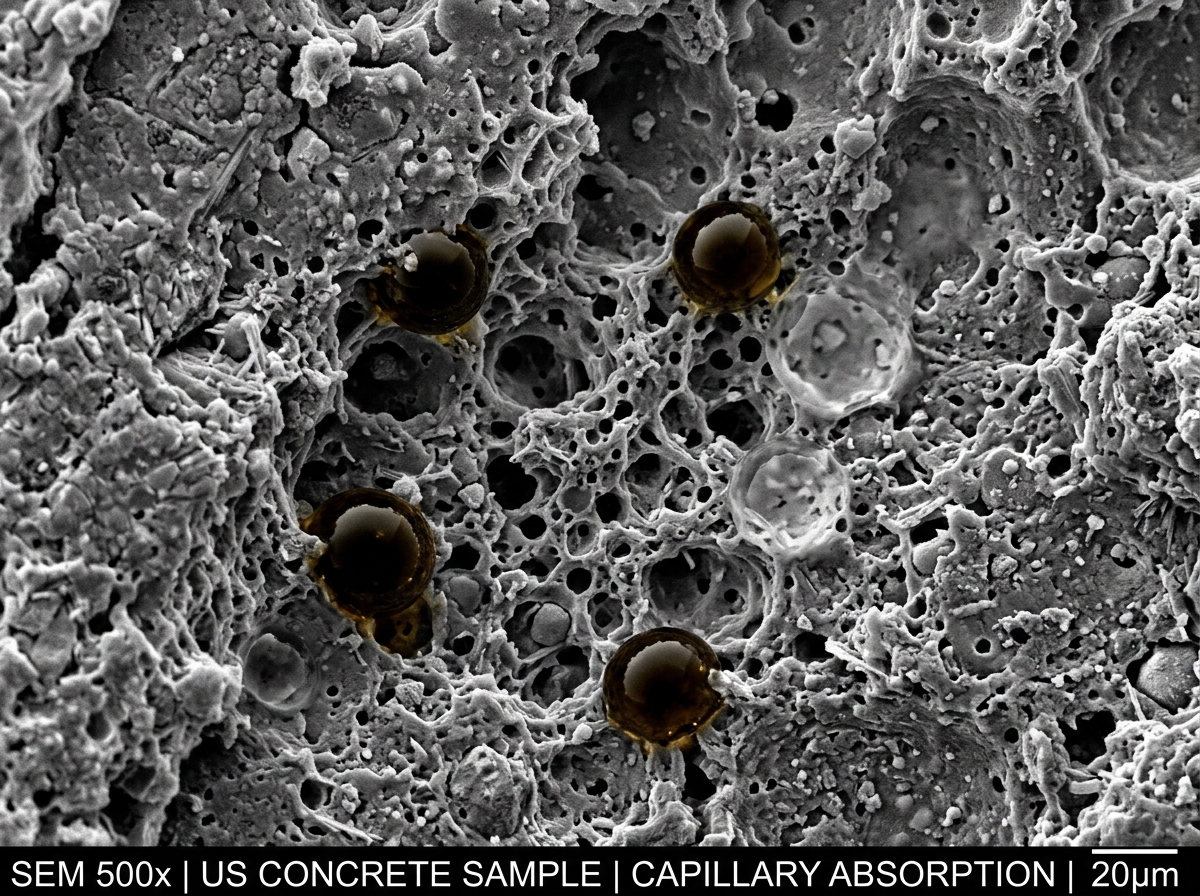
Concrete is a lot like a giant, gray sponge. If you look at it under a microscope, it is full of tiny pores and capillaries. When you park a car with a small oil leak on bare concrete, that oil travels deep into those pores. This makes cleaning nearly impossible and prevents new paint from sticking.
This is why Choosing the Best Outdoor Concrete Coatings for Durable, Beautiful Patios in Monroe, GA is such a critical step for homeowners. The same logic applies to your driveway. By using a coating that fills and caps these pores, you create a surface that is “non-stick.” Oil, grease, and even red Georgia clay can be rinsed away with a garden hose rather than requiring a heavy-duty degreaser and hours of scrubbing.
Elevating Aesthetics: Design Options for Your High-Performance Driveway Coating
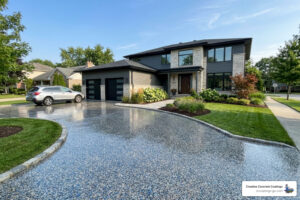
Choosing a high-performance system doesn’t mean you’re stuck with “industrial gray.” In fact, modern coatings offer more design flexibility than any driveway paint and sealer on the market:
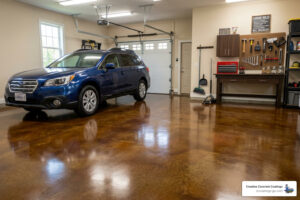
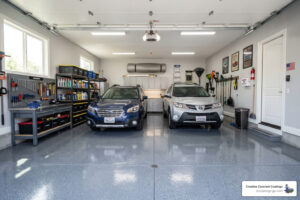
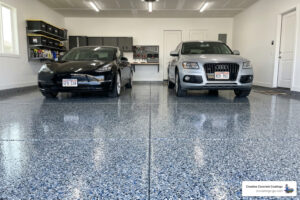
- Decorative Flakes: These are our most popular option. We broadcast vinyl flakes into the base coat to create a granite or terrazzo look. This isn’t just for looks; the flakes provide excellent slip resistance and hide minor imperfections in the concrete.
- Low-Matte vs. Semi-Gloss: Depending on your home’s style, you can choose a finish that ranges from a natural, low-luster matte to a high-end semi-gloss that makes your driveway look like a showroom.
- Stamping and Overlays: If your concrete is structurally sound but looks “ugly,” a concrete resurfacer or overlay can be applied. These are thin layers of polymer-modified cement that can be stamped to look like European cobblestone, brick, or flagstone.
Step-by-Step: How to Apply Driveway Protective Coatings
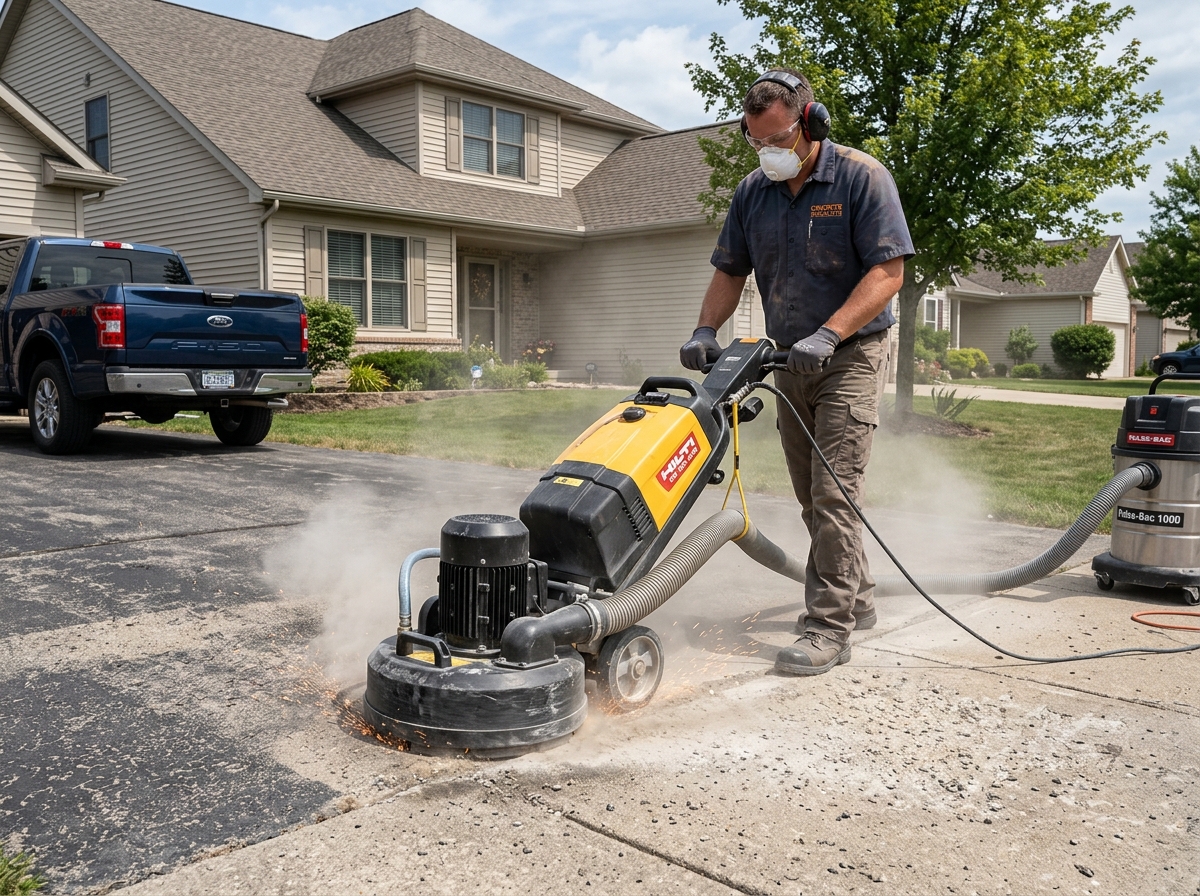
If you are a DIY enthusiast, you might be tempted to grab a roller and start dumping product. Slow down! The secret to a coating that lasts 10+ years isn’t the application—it’s the preparation. At Creative Concrete Coatings, we spend 75% of our time on prep and only 25% on the actual “painting.”
Here is the professional process for a “stop the peel” finish:
- Deep Cleaning: We use industrial-strength pressure washers to remove dirt and mold.
- Oil Spot Priming: Standard soap won’t work on deep oil stains. We use specialized emulsifiers to pull oil out of the concrete pores so the coating can actually bond.
- Crack and Pothole Repair: You can’t just paint over a crack; it will show through in weeks. We use high-strength polyurea fillers that cure harder than the concrete itself to “stitch” those cracks back together.
- The Profile (Grinding): This is the most important step. We use diamond-grinding machines to “open” the pores of the concrete. This creates a rough surface (similar to 80-grit sandpaper) that allows the coating to “root” itself into the slab.
- Application: We typically use a “squeegee and back-roll” method. The squeegee pushes the material into the pores, while the roller ensures a perfectly even thickness across the entire surface.
The Foundation of Durability: Professional Prep for Your High-Performance Coating Application
Why do we emphasize diamond grinding over “acid etching”? Acid etching is a common DIY method using muriatic acid, but it is inconsistent and dangerous. It often leaves behind a residue that causes the driveway paint and sealer to fail.
Professional diamond grinding ensures a uniform “Concrete Surface Profile” (CSP). It also addresses safety concerns like lead dust. If your driveway was painted decades ago, sanding it could release toxic lead particles. Our professional equipment uses HEPA-filtered vacuum systems to capture 99% of dust at the source.
When homeowners ask Who’s the Best Company for Outdoor Concrete Coatings in Monroe, GA, they are usually looking for someone who doesn’t cut corners on this prep phase. A coating is only as good as the surface beneath it.
Polyaspartic vs. Epoxy: The Ultimate Durability Comparison
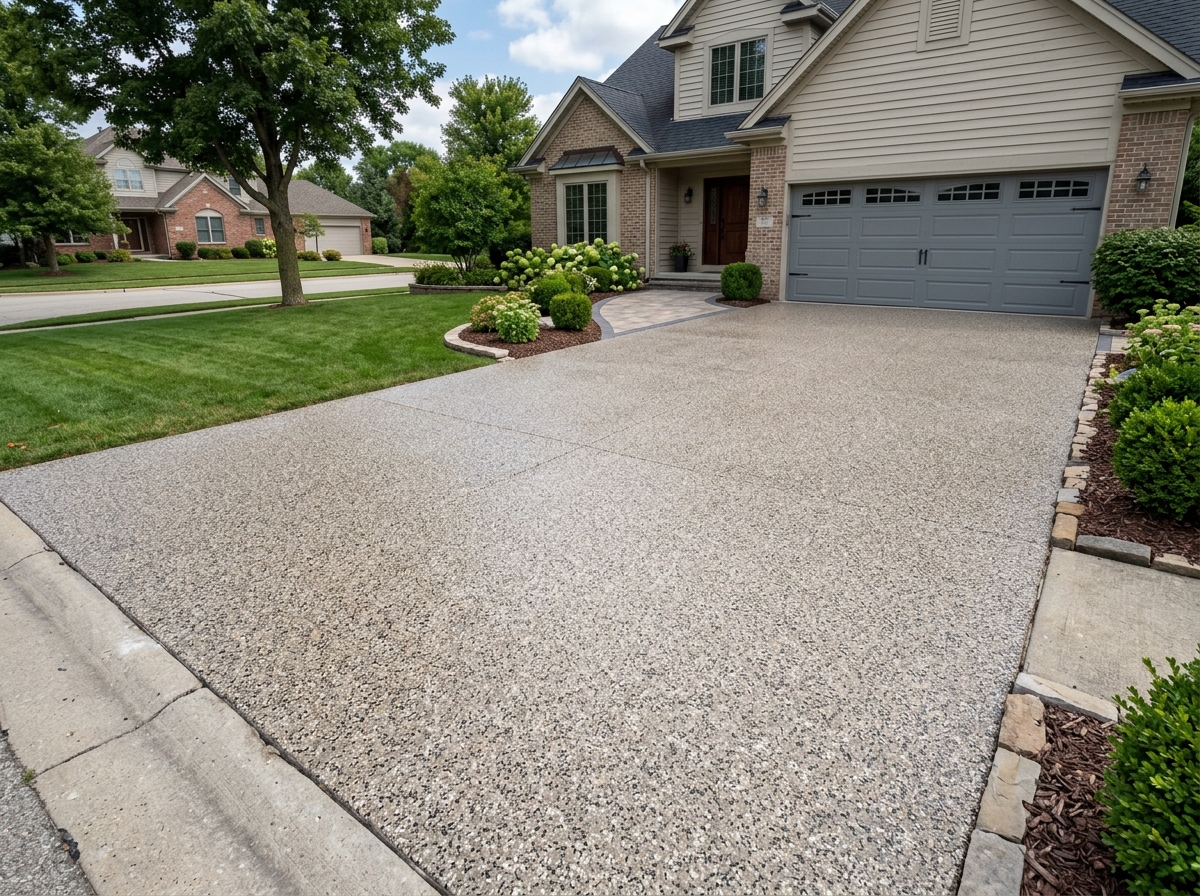
If you’ve researched garage floors, you’ve heard of epoxy. But for outdoor driveways in Georgia, polyaspartic is the undisputed heavyweight champion.
Epoxy is a fantastic product, but it has one major weakness: the sun. Traditional epoxy is not UV-stable. If you apply it to a driveway in Dacula or Buford, the sun’s rays will cause it to turn a sickly yellow color (ambering) and eventually become brittle and chalky. Epoxy is best kept indoors.
Polyaspartic coatings were originally developed to protect bridges and piers. They are:
- 4x Stronger than Epoxy: They resist scratches from gravel in your tires and impact from dropped tools.
- UV Stable: They will never yellow or fade, regardless of how much direct Georgia sun they get.
- One-Day Installation: While epoxy takes days to cure, we can often prep, coat, and finish a polyaspartic driveway in a single day.
- Chemical Resistant: Gas, oil, and road salt won’t leave a mark.
For a deeper dive into these materials, check out The Ultimate Guide to Custom Epoxy and Pool Deck Coatings. While that guide focuses on pool decks, the science of durability remains the same for your driveway.
Maintenance and Longevity: Making Your Driveway Last
Once your high-performance coating is down, you can throw away your heavy-duty scrub brushes. Maintenance is incredibly simple:
- Cleaning: A simple leaf blower or broom handles 90% of the work. For a deeper clean, a garden hose and a mild, non-abrasive soap (like Dawn) are all you need. Avoid harsh chemicals or citrus-based cleaners that can dull the finish over time.
- Pressure Washing: You can still pressure wash your coated driveway, but you won’t need to do it nearly as often.
- Cure Times: One of the biggest perks of our polyaspartic systems is the “drive-ready” window. While some driveway paint and sealer products require you to stay off the surface for a week, our systems are typically ready for foot traffic in 4-6 hours and vehicle traffic in 24 hours.
- Eco-Friendly Options: We prioritize low-VOC (Volatile Organic Compounds) formulas. This means no “chemical smell” lingering around your home for weeks and a safer environment for your family and pets.
Frequently Asked Questions about Driveway Protection
How soon can I drive on a newly coated driveway?
For standard hardware store sealers, you often have to wait 48 to 72 hours. However, with our professional polyaspartic systems, you can usually park your car back in the driveway just 24 hours after the final topcoat is applied. Always check the specific weather conditions, as high humidity can slightly extend cure times in places like Braselton or Hoschton.
Can I apply driveway paint over an old sealer?
Generally, no. Most high-performance coatings and even basic paints require a “clean slate.” If you apply new paint over a failing, peeling sealer, the new paint will simply peel off along with the old layer. We always recommend removing the old product through diamond grinding or professional-grade chemical stripping to ensure the new coating can bond directly to the concrete.
Is DIY driveway sealing better than professional installation?
DIY is certainly an option, but it is rarely “better.” Most DIY failures happen because the homeowner couldn’t achieve the necessary surface profile (grinding) or used a product that wasn’t UV-stable. When you consider that a professional coating can last 15 years compared to a DIY paint job that lasts 2 years, the professional route is almost always the superior choice for long-term durability. Plus, you get a warranty!
Conclusion
Your driveway is one of the largest visual elements of your home. Don’t let it be defined by cracks and peeling paint. Whether you are in Monroe, Suwanee, or Watkinsville, the key to a beautiful, lasting entrance is moving beyond basic driveway paint and sealer and choosing a high-performance system.
At Creative Concrete Coatings, we bring over 25 years of experience and more than 455,000 square feet of installed excellence to every project. We pride ourselves on our 100% satisfaction guarantee and our commitment to using the most durable, UV-stable products available on the market today.
Ready to stop the peel and give your home the entrance it deserves? Contact us for a professional consultation and let us show you how a one-day installation can transform your driveway for the next decade and beyond.