
Stain Game Strong: Choosing the Right Indoor Concrete Finish
What Is Acid Based Concrete Stain — And Is It Right for Your Floor?
Acid based concrete stain is a reactive chemical solution that permanently colors concrete by bonding with the minerals already inside the slab — not just coating the surface. Unlike paint, it cannot chip, peel, or flake off.
Quick answer: Here’s how acid stain compares to other common indoor concrete finishes:
| Finish Type | How It Works | Durability | Look |
|---|---|---|---|
| Acid based concrete stain | Chemical reaction with concrete minerals | Permanent — lasts as long as the concrete | Translucent, variegated, natural stone-like |
| Epoxy coating | Bonds to surface as a top layer | Very durable, but can peel over time | Solid or flake, high-gloss |
| Water-based stain | Pigment penetrates surface | Good, but less reactive | More uniform, less variation |
| Concrete paint | Sits on top of surface | Prone to chipping and peeling | Opaque, flat |
Acid stain creates a look you simply can’t replicate with paint or standard coatings. Every slab reacts differently — meaning your floor ends up with a one-of-a-kind, natural finish that reflects the unique mineral makeup of your concrete.
That’s what makes it so appealing. And also what makes it easy to get wrong.
The results depend heavily on surface prep, concrete age, and application technique. Done right, it’s stunning and permanent. Done wrong, you get patchy, washed-out color that can’t easily be fixed.
I’m Scott Shannon, owner of Creative Concrete Coatings and a veteran with decades of hands-on experience in concrete coatings — including acid based concrete stain on residential and commercial surfaces across Georgia. In this guide, I’ll walk you through everything you need to know to get it right.
The Science Behind Acid Based Concrete Stain
To understand why an acid based concrete stain looks so different from a bucket of hardware store paint, we have to look at the chemistry happening under your feet. These stains aren’t just “paint for rocks.” They are sophisticated mixtures of water, hydrochloric acid, and acid-soluble metallic salts.
When we apply this solution to your floor, the hydrochloric acid lightly etches the surface, allowing the metallic salts to penetrate deep into the concrete. Once inside, these salts experience a chemical bond with the calcium hydroxide (slaked lime) naturally present in the cement. This reaction transforms the minerals into permanent oxides.
Think of it like tattooing your concrete rather than putting on a sweater. Because the color becomes a physical part of the floor’s structure, it features incredible UV stability and won’t fade under the Georgia sun streaming through your windows. However, because we are dealing with acids, safety is paramount. We always recommend reviewing the Safety Data Sheet to understand the handling requirements of these materials.
How Acid Based Concrete Stain Reacts with Your Floor
The “magic” of the reaction depends entirely on the ingredients of your concrete. Every slab has a different mineral content and level of cement hydration. This is why two different houses in Monroe or Lawrenceville can use the exact same bottle of stain and end up with two completely different floors.
For the stain to work, the concrete must be “reactive.” This generally means the slab needs a minimum 28-day cure time (though many professionals prefer 45 days) to ensure the chemical hydration process is complete. If the concrete is too new, the excess moisture can water down the acid, leading to weak, muddy colors.
Furthermore, slab porosity is a major factor. If the concrete is “tight” or power-troweled to a mirror finish, the acid can’t get in. On the flip side, some modern concrete mixes use fly ash (often exceeding 10%). Fly ash can actually block the reaction because it reduces the available portland cement minerals that the acid needs to “bite” onto. In these cases, we often have to mechanically sand the surface to expose the reactive minerals underneath.
Color Variations and Natural Mottling
If you are looking for a perfectly uniform, solid color, acid based concrete stain is probably not for you. This product is famous for its variegated intensity. You’ll see deep, dark pockets next to lighter, translucent veining—a look often described as leather-like or resembling natural stone.
Most acid stains lean toward earthy tones: tans, browns, terra cottas, and soft greens. These colors are influenced by the age of the slab; older concrete might react more subtly than a fresh, mineral-rich surface. You can explore the range of possibilities on our our-colors page to see how different reactive agents produce varied results.
Preparing Your Surface for Success
Preparation isn’t just the first step; it’s about 90% of the job. You can’t just move the couch and start spraying. Any barrier between the acid and the concrete will result in a “ghost” or a spot where the stain simply didn’t take.
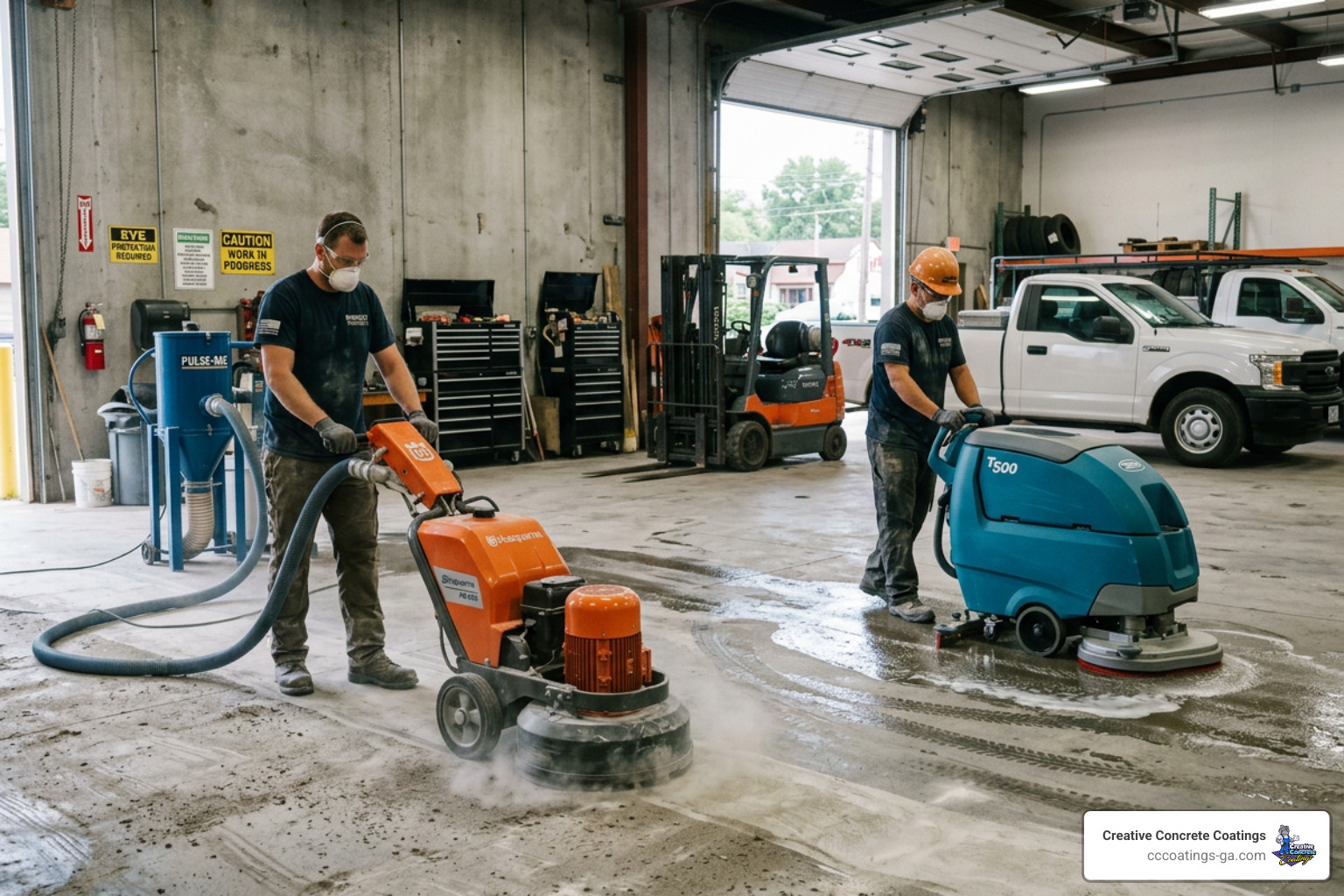
We start with heavy-duty degreasing to remove oils, waxes, and kitchen grease. If there’s an old sealer present, it must be mechanically removed—acid stain will not work over an existing coating. We often perform a water absorption test: if you pour water on the floor and it beads up, the stain will bead up too. The water must soak in for the stain to be successful.
Masking is also critical. Because we apply this via sprayers, the “mist” can travel. We mask off walls, baseboards, and adjacent cabinets with plastic sheeting to prevent permanent orange or brown speckles on your drywall. For a visual walkthrough of the prep and spray, you can watch this guide on How to Apply Acid Stain.
Essential Tools for Application
Don’t reach for your metal garden sprayer! The hydrochloric acid in the stain will eat through metal components in seconds, potentially ruining your equipment and spitting rust chunks onto your floor. You need:
- All-plastic pump sprayer: Ensure it has acid-resistant seals and no metal parts.
- Acid-resistant brushes: Useful for “walking” the stain into the pores in a circular motion.
- Spiked shoes: These allow us to walk over the wet stain without leaving footprints or disrupting the reaction.
- Wet vacuum: Essential for the cleanup and neutralization phase.
- Microfiber mops: For final rinsing and ensuring no residue remains.
The Application Process for Acid Based Concrete Stain
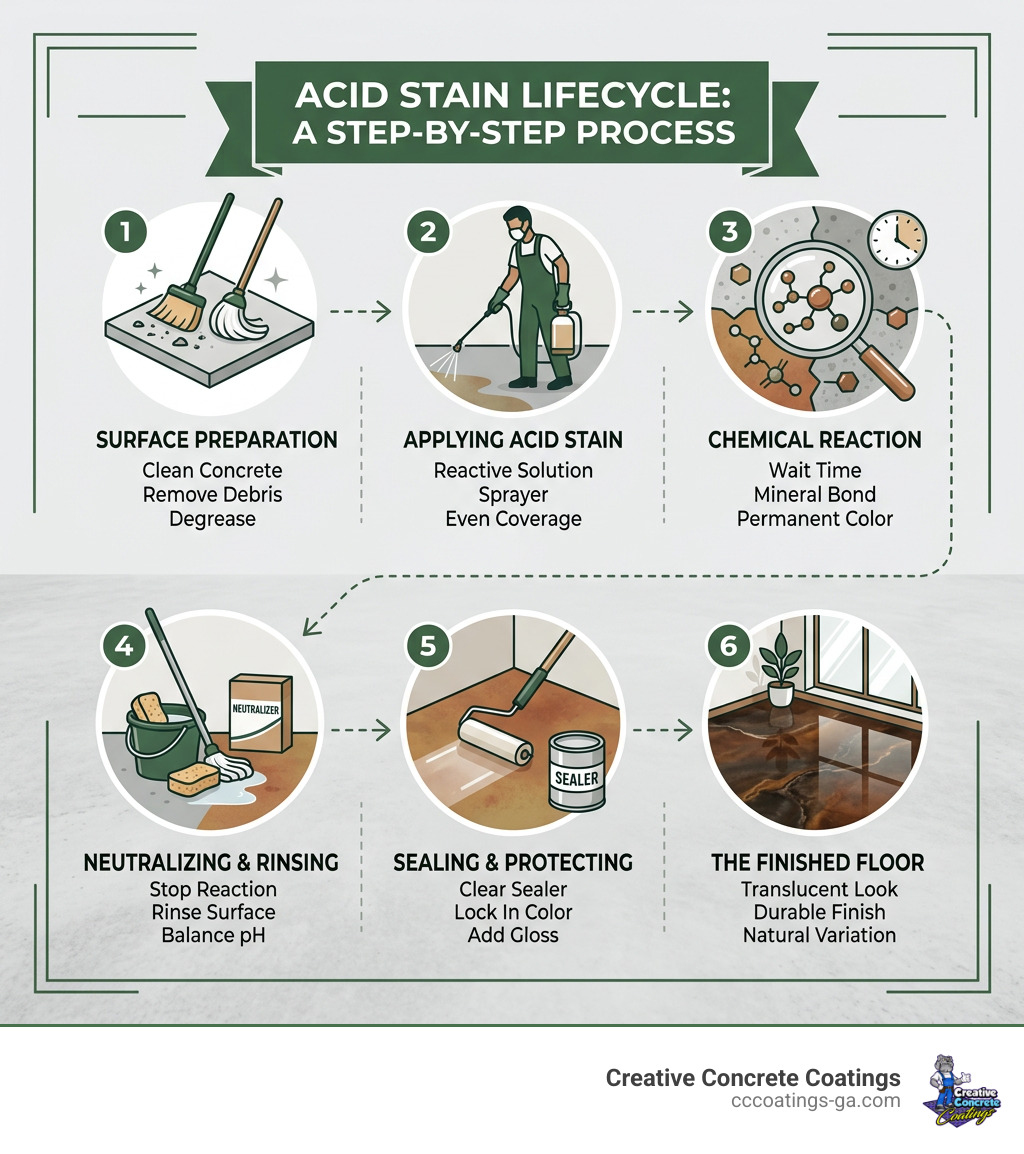
When we apply the stain, we work in a random, circular motion. The goal is to avoid “corn rows” or predictable patterns. We maintain a “wet edge,” meaning we never let one section dry before overlapping with the next.
The reaction time is where the patience comes in. Most stains require between 5 to 12 hours to fully develop. Some premium “Artist Grade” stains can cover up to 400 square feet per gallon, while more standard professional mixes cover 200-300 square feet. If you want a deeper, richer color, we might apply multiple coats, allowing the first to dry (or at least react for several hours) before the second pass.
Comparing Stains to Other Indoor Finishes
When homeowners in Johns Creek or Alpharetta ask us about indoor finishes, they are usually deciding between a reactive stain and a high-performance coating. Here is how they stack up:
| Feature | Acid Based Stain | flake-floor | solid-color-industrial | grind-and-clear |
|---|---|---|---|---|
| Primary Use | Living areas, Patios | Garages, Basements | Shops, Warehouses | Lofts, Modern Retail |
| Aesthetic | Natural, Mottled | Textured, Multi-color | Clean, Opaque | Raw, Industrial |
| Thickness | Penetrating (Zero) | High-build (Thick) | Medium-build | Sealed Surface |
| Texture | Smooth (depends on sealer) | Slip-resistant | Smooth/Grip | Smooth |
Benefits Over Surface Coatings
Why choose a stain over an epoxy? One word: breathability. Concrete is a porous material that “breathes” moisture vapor. Because acid based concrete stain is a penetration-based finish, it doesn’t trap moisture the way a thick plastic coating might. This makes it incredibly resistant to peeling or “blistering.”
Furthermore, there is no “wear-through” in the traditional sense. Since the color is deep in the pores, you won’t see gray concrete peeking through if you drag a chair across the floor (though you might scratch the sealer). It provides a stone-like appearance that feels sophisticated and permanent, rather than a “covered up” look.
Long-Term Care and Safety Precautions
Working with acid requires a healthy dose of respect for the materials. We always wear full PPE, including acid-resistant gloves, goggles, and respirators, especially in confined indoor spaces like basements in Buford or kitchens in Athens.
Once the stain has reacted for the allotted time (usually overnight), the acid is still active on the surface. It must be neutralized. We use a solution of water and ammonia (or a specialized neutralizer/degreaser) to bring the pH balance of the concrete back to a neutral 7. If you skip this, your sealer will fail, and the color may continue to change unpredictably.
Neutralization and Residue Removal
Neutralization is a “scrub and vac” process. We apply the alkaline solution and scrub the floor to loosen the metallic residue. Then, we use a wet vacuum to suck up the slurry. We repeat this with a clear water rinse until the water coming up is crystal clear.
We use the “white rag test”: wipe a clean white cloth across the dry, neutralized floor. If any color comes off on the rag, the floor isn’t clean enough. Any leftover residue will act as a “bond breaker,” preventing your sealer from sticking.
Sealing and Maintenance
A raw, stained floor looks dull and dusty—almost like a chalkboard. The “pop” happens when you apply the sealer.
- Solvent-based sealers: These act like “wetting” the floor, making the colors vibrant and deep. They are great for that “wow” factor but have higher VOCs.
- Water-based sealers: These offer a more natural, “matte” or satin look and are much friendlier for indoor air quality in occupied homes.
- High-traffic wax: For indoor residential floors, we often apply a sacrificial coat of floor wax over the sealer. This takes the scuffs and scratches, protecting the permanent finish underneath.
In our Georgia climate, we recommend an inspection every year and a light re-sealing schedule every 2 to 3 years for high-traffic areas to keep the floor looking brand new.
Frequently Asked Questions about Concrete Staining
Can acid stain be used on new concrete?
Yes, but you must wait! The concrete needs to finish its initial hydration process. We require a minimum 28-day cure. If the moisture content is too high, the stain won’t penetrate deeply, and your color consistency will be poor.
Why does the color look dull before sealing?
Don’t panic! When the stain dries after neutralization, it looks like a dusty, faded version of what you wanted. This is the “matte state.” The sealer acts as the activator that brings the translucent depth back to life. It’s like looking at a dry pebble on the beach versus one you just pulled out of the water.
How do I fix uneven or weak color results?
Weak color is usually caused by surface contaminants or fly ash interference. If the floor didn’t react, it’s likely because the “pores” were closed. In some cases, we can perform a light mechanical etching or re-application of a more concentrated stain to darken the areas that didn’t take.
Conclusion
At Creative Concrete Coatings, we’ve seen it all over our 25+ years of experience. From transforming basements in Monroe to massive commercial floors in Dacula and Braselton, we know that a successful acid based concrete stain project is a blend of science and art. With over 455,000 square feet installed and a 100% satisfaction guarantee, we take the guesswork out of the “Stain Game.”
If you want a floor that looks like a custom piece of stone rather than a slab of gray, we are here to help. Our team serves the entire region, from the historic streets of Athens to the modern homes of Alpharetta and Johns Creek.
Ready to see what your concrete is hiding? Contact us for a professional consultation and let’s build something permanent together.