What is the Best Garage Floor Surface for Your Home
Why Choosing the Best Garage Floor Surface Matters More Than You Think
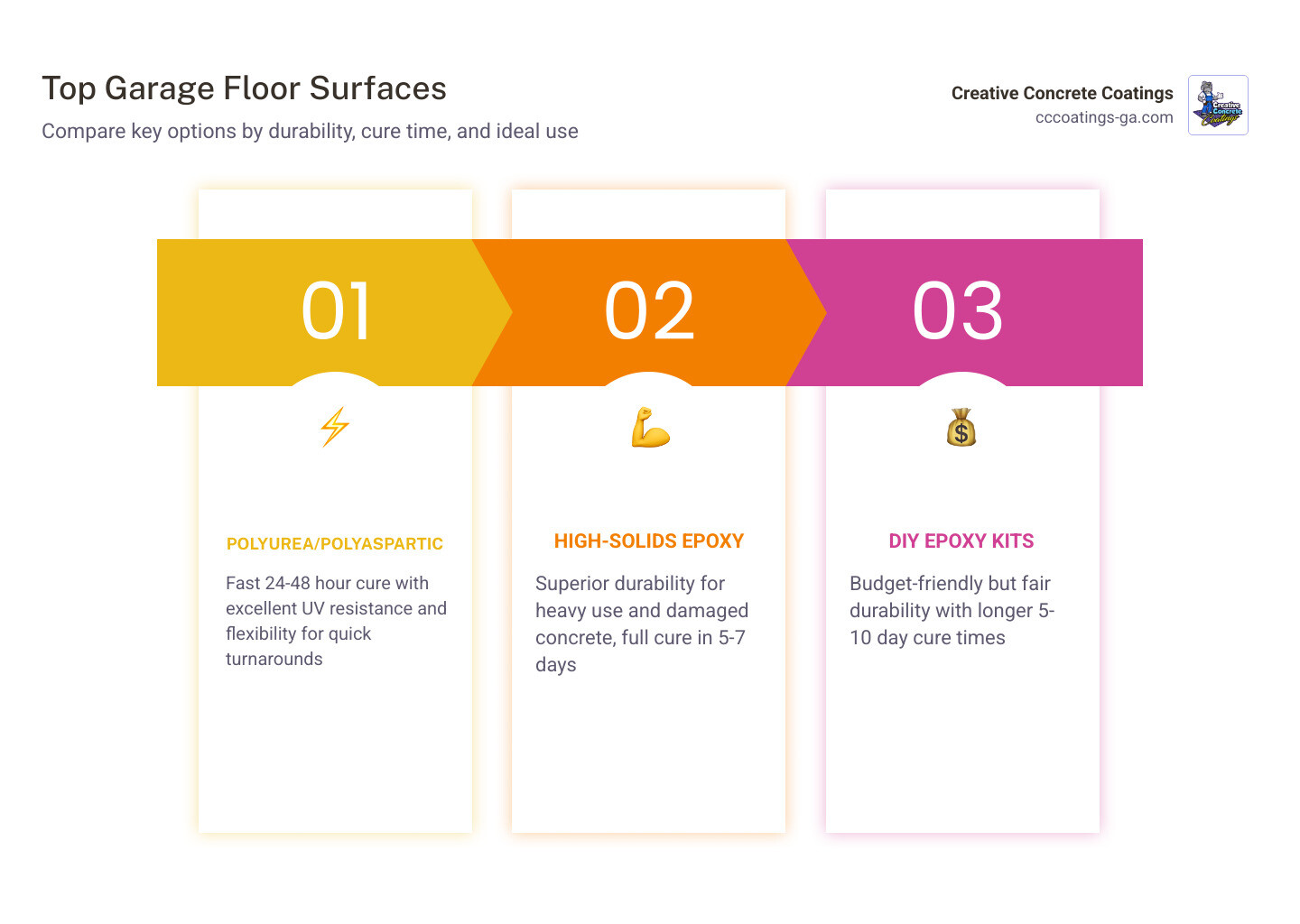
The best garage floor surface for most homeowners is a professionally installed polyurea or high-solids epoxy coating system — but the right choice depends on how you use your garage, your concrete’s condition, and how long you want it to last.
Here’s a quick comparison to help you decide at a glance:
| Surface Type | Best For | Durability | Cure Time |
|---|---|---|---|
| Polyurea/Polyaspartic | Fast turnaround, UV exposure | Excellent | 24-48 hrs |
| High-Solids Epoxy | Heavy use, damaged concrete | Excellent | 5-7 days |
| DIY Epoxy Kits | Simple projects | Fair | 5-10 days |
| Interlocking Tiles | Temporary or rental spaces | Good | Instant |
| Garage Floor Paint | Short-term fix only | Poor | 1-2 days |
| Rubber Mats/Rolls | Gyms, quick installs | Fair | Instant |
Your garage floor takes a beating every single day. Hot tires, oil drips, road salt, dropped tools, and heavy foot traffic create wear that bare concrete simply cannot handle long-term. The wrong surface peels, yellows, or fails within a year or two — leading to more frustration and maintenance than doing it right the first time.
And here’s the thing most people don’t realize: the coating itself is only half the equation. Surface preparation — cleaning, grinding, and moisture testing — is what actually determines whether your floor lasts 2 years or 20.
I’m Scott Shannon, owner of Creative Concrete Coatings and a USMC veteran with decades of hands-on experience transforming concrete surfaces across Georgia — and helping homeowners find the best garage floor surface for their specific needs is exactly what we do every day.
Key Factors in Choosing the best garage floor surface
When you start looking for the best garage floor surface, it’s easy to get distracted by pretty colors and shiny finishes. But in places like Monroe, GA, or Lawrenceville, GA, where humidity and temperature swings are part of life, you need to look under the hood. Here are the non-negotiable factors we evaluate before every installation.
Chemical and Stain Resistance
Your garage isn’t just a parking spot; it’s a chemistry lab. Between motor oil, antifreeze, brake fluid, and the road salt brought in during those rare Georgia winter dustings, your floor faces constant chemical warfare. A high-quality surface must be non-porous. While bare concrete soaks up oil like a sponge, leaving permanent “shadows,” the best garage floor surface will allow these fluids to bead up for easy cleaning.
Impact and Abrasion Durability
If you’ve ever dropped a heavy wrench or moved a floor jack, you know concrete can chip. We look for coatings with high “mil” thickness. In the coating world, a “mil” is 1/1000th of an inch. While a basic hardware store paint might only be 1 or 2 mils thick, professional systems like a flake-floor can reach 15 to 30 mils. This thickness acts as a shock absorber for your concrete.
Moisture Vapor Transmission
This is the silent killer of garage floors in the South. Moisture lives in the soil beneath your home and naturally moves upward through the porous concrete. If you seal that concrete with a non-breathable, low-quality DIY kit, that moisture pressure will eventually cause the coating to bubble and peel. We use moisture-tolerant primers and breathable systems like Sikafloor® Decodur WB to ensure the bond stays strong even when the ground is saturated.
UV Stability and Yellowing
Does your garage get a lot of sunlight? Standard epoxies are notorious for “ambering” or yellowing when exposed to UV rays. If you want your floor to stay the same color it was on day one, you need a UV-stable topcoat, often found in polyaspartic systems.
Hot Tire Pickup
Have you ever seen a garage floor where the coating has peeled away exactly where the tires sit? That’s hot tire pickup. After a long drive on a hot Georgia afternoon, your tires can reach 180 degrees. As they cool, they literally shrink and grab onto the floor coating. If the bond between the coating and the concrete is weak (common with DIY kits), the tire will rip the floor right off the slab.
Top Garage Flooring Options Compared
Choosing the best garage floor surface often comes down to a battle between three main contenders: Epoxy, Polyurea/Polyaspartic, and modular options like tiles or mats.
| Feature | High-Solids Epoxy | Polyurea/Polyaspartic | Interlocking Tiles |
|---|---|---|---|
| Adhesion | Superior (Molecular Bond) | Excellent | None (Floats) |
| UV Resistance | Low (unless top-coated) | High | Variable |
| Install Time | 2-3 Days | 1 Day | Hours |
| Workshop Use | Best for heavy loads | Great for impact | Good for feet, bad for welding |
| Slip Resistance | High (with additives) | High (with additives) | High |
Vehicle Traffic vs. Workshop Use
If your garage is strictly for parking high-end vehicles, aesthetics and ease of cleaning are your priorities. However, if you’re running a workshop in Johns Creek or Suwanee, you need a surface that can handle welding sparks, grinding, and the heavy weight of engine hoists.
For heavy workshop use, we often recommend a solid-color industrial epoxy. It’s incredibly thick and can handle the “drag” of heavy equipment without tearing. Conversely, interlocking tiles, while great for aesthetics, can sometimes warp under the localized heat of welding or the extreme weight of a long-term car project.
Slip Resistance and Safety
A shiny floor looks great, but a wet, shiny floor is a skating rink. The best garage floor surface always includes an anti-slip additive. In our flake systems, the vinyl chips themselves provide a natural texture, but we can also add aluminum oxide or glass beads to the topcoat to ensure you have grip even when coming in from a rainstorm.
High-Performance Epoxy: The best garage floor surface for Durability
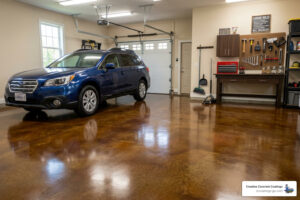
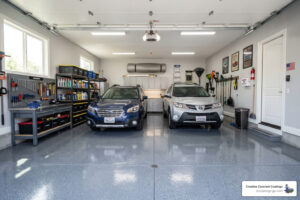
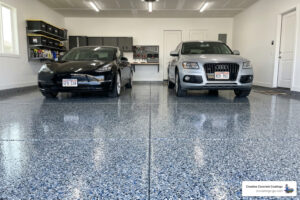
When people talk about the “gold standard” of garage flooring, they are usually talking about a full broadcast flake-floor. This isn’t your average “garage paint.”
The Power of 100% Solids
Most DIY kits are water-based or solvent-based, meaning as they dry, a large portion of the liquid evaporates into the air. This is called “shrinkage.” A 100% solids epoxy has no evaporative loss. If we put down 10 mils of wet product, you have 10 mils of dry, rock-hard protection. This creates a much thicker, more durable shield for your concrete.
Why We Love Flake Systems
A full broadcast flake system involves throwing vinyl chips into a wet base coat until the floor is completely covered. This does three things:
- Durability: It adds an extra layer of “armor” to the floor.
- Aesthetics: It hides imperfections in the concrete and makes your garage look like a professional showroom.
- Maintenance: It is incredibly good at hiding dust and salt tracks between cleanings.
If you want to see why this is the-best-garage-floor-epoxy-to-make-your-neighbors-jealous, just look at the depth and texture it provides compared to a flat, grey paint.
Polyurea and Polyaspartic Systems: The best garage floor surface for Fast Cures
In our world, not everyone can wait a week to park their car back in the garage. This is where one-day garage coatings come into play.
Rapid Return-to-Service
Polyurea coatings are the sprinters of the flooring world. While epoxy might take 24 hours to be walkable and 7 days for vehicle traffic, some polyurea systems can be walked on in 8 hours and handled wheel traffic in as little as 48 to 72 hours. This is ideal for busy families in areas like Dacula or Buford who can’t leave their belongings on the driveway for a week.
Flexibility and Strength
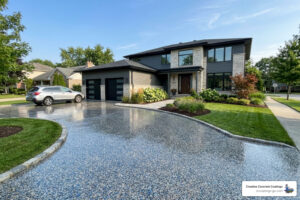
Polyurea is naturally more flexible than epoxy. Think of epoxy as a hard shell and polyurea as a tough, slightly elastic membrane. This flexibility makes it highly resistant to impact and less likely to crack if the concrete underneath undergoes minor shifting. It’s also naturally UV stable, meaning it won’t yellow even if your garage door stays open all day.
Why Professional Coatings Outperform DIY Solutions
We get asked all the time: “Can’t I just buy a kit at the big-box store?” You certainly can, but there is a reason why those kits often end up being a poor long-term investment for your home.
Industrial-Grade Resins vs. Consumer Kits
The “epoxy” sold in retail stores is often a heavily thinned-out version of the real thing. It’s designed to be easy to stir and apply, but it lacks the “solids” content needed for a permanent bond. Professional-grade resins, like those we use at Creative Concrete Coatings, are formulated for industrial environments. They bond at a molecular level to the concrete, becoming a part of the slab rather than just a layer on top.
Specialized Equipment
A professional installer doesn’t just show up with a mop and a bucket. We use heavy-duty commercial concrete coatings equipment, including industrial diamond grinders equipped with HEPA vacuums. This equipment is necessary to “open” the pores of the concrete. Without this mechanical profiling, the coating is just sitting on the surface, waiting for a hot tire to pull it off.
Adhesion Testing
Do you know if your concrete has a “sealer” on it from when the house was built? Do you know the moisture content of your slab? Professionals perform these tests before a drop of product hits the floor. If you’re looking for who-installs-epoxy-floors-in-monroe-ga-that-can-handle-heavy-traffic-and-still-look-great, you want a team that understands the science of adhesion, not just the art of painting.
The Importance of Surface Preparation for Longevity
If you take nothing else away from this article, remember this: Preparation is 90% of the job. You could have the highest-quality, most advanced coating in the world, but if you put it on a dirty or unprepared floor, it will fail.
Mechanical Profiling (Diamond Grinding)
Many DIY kits suggest “acid etching” the floor. While acid can clean the surface, it rarely provides the deep, consistent profile needed for a long-term bond. We use diamond grinding to remove the “laitance” (the weak, dusty top layer of concrete) and expose the strong aggregate beneath. This creates a surface texture similar to 80-grit sandpaper, which is the perfect “anchor” for the coating.
Crack and Divot Repair
Concrete moves. Over time, every slab in Athens or Braselton will develop cracks. If you simply coat over them, the cracks will eventually show through. We use high-strength polyurea crack fillers that set in minutes and can be ground flat. This ensures your final floor is seamless and smooth.
Moisture Testing
Before we install any grind-and-clear or flake system, we check for moisture. High moisture levels require a specialized moisture-vapor barrier primer. Skipping this step is the number one reason for “delamination” (the coating peeling off in sheets).
Frequently Asked Questions about Garage Flooring
How long does it take for a garage floor to cure?
Cure times vary wildly based on the system.
- Polyurea/Polyaspartic: Walkable in 4–8 hours; vehicles in 48–72 hours.
- 100% Solids Epoxy: Walkable in 24 hours; vehicles in 5–7 days.
- Water-Based Epoxy: Can take up to 10 days to completely cure for heavy vehicle traffic.
Environmental factors like the high humidity we often see in Loganville or Watkinsville can also extend these times. We always provide a specific “return to service” schedule for every project we complete.
What causes garage floor coatings to peel?
The most common culprits are:
- Poor Preparation: Not grinding the floor to remove sealers or oil.
- Moisture: Water vapor pushing the coating off from underneath.
- Hot Tire Pickup: Low-quality resins softening under heat.
- Contamination: Oil or grease spots that weren’t properly neutralized before coating.
Which surface is best for heavy workshop use?
For a true “working” garage involving welding, grinding, and heavy tools, we recommend a solid-color industrial system with an aliphatic urethane topcoat. This combination provides:
- Heat Resistance: To handle sparks from grinding or welding.
- Impact Resistance: To protect the slab from dropped heavy tools.
- Chemical Resistance: To withstand spills from oils and solvents.
If you are more concerned about standing for long periods, you might consider options like rubber rolls or mats in specific work zones, but for the overall floor, a hard coating is superior.
Are there specific solutions for home gyms?
Yes! If you’re turning your garage into a fitness center in Alpharetta, a rubber roll or interlocking rubber tiles are fantastic. They provide the cushion needed for joints and protect the concrete from dropped weights. However, many of our customers choose a flake floor first for its ease of cleaning and then place specialized mats only in the lifting areas.
How do I maintain my new garage floor?
Maintenance is surprisingly simple. For a coated floor:
- Sweep regularly: To remove abrasive dirt and sand.
- Mop occasionally: Use a mild, pH-neutral cleaner (avoid soap-based cleaners which can leave a film).
- Wipe spills: While the floors are chemical-resistant, it’s always best to wipe up oil or chemicals promptly to prevent any potential staining over years of use.
Conclusion
Finding the best garage floor surface doesn’t have to be a headache. Whether you’re looking for the rapid turnaround of a polyurea system or the legendary durability of a full-broadcast flake epoxy, the key is professional-grade materials and obsessive surface preparation.
At Creative Concrete Coatings, we bring over 25 years of experience to every job site. We’ve installed more than 455,000 square feet of high-performance flooring across Monroe, GA, and the surrounding communities. We are proud to be a veteran-owned business that stands behind our work with a 100% satisfaction guarantee.
Ready to stop staring at that dusty, cracked concrete and start enjoying a showroom-quality garage? Whether you’re in Hoschton, Johns Creek, or anywhere in the greater Atlanta area, we’re here to help you make the right choice the first time.
We are the #1 choice for epoxy garage floor coatings in Monroe, GA and we can’t wait to help you transform your space. Contact us today to discuss your project!