Flake It Til You Make It: A Guide to Epoxy Flake Driveways
The Benefits of an Epoxy Concrete Driveway: Here’s What You Need to Know
An epoxy concrete driveway is one of the most durable, low-maintenance surface upgrades available for residential and commercial properties — but how well it holds up depends heavily on the coating system used and how the concrete is prepared.
Quick answer: Epoxy driveway durability at a glance
| Factor | What to Expect |
|---|---|
| Lifespan | 8-15 years with proper prep and maintenance |
| Strength | Up to 8,000 psi compressive strength |
| Vehicle traffic | Ready in 48-72 hours after installation |
| UV resistance | Requires UV-stable polyaspartic topcoat |
| Maintenance | Low — occasional cleaning and topcoat refresh every 3-5 years |
| Best for | Concrete surfaces (not asphalt) |
Your driveway is the first thing people see. And if your concrete is cracked, stained, or just plain tired-looking, it drags down the whole appearance of your property. Epoxy coatings fix that — while also adding a layer of serious protection against oil, chemicals, tire marks, and Georgia’s intense summer heat.
But not all epoxy systems are built the same. A basic one-part epoxy paint from a hardware store is a very different product from a professional multi-layer system with a polyaspartic topcoat and decorative flake broadcast. Understanding that difference is the key to knowing what you’re actually getting.
I’m Scott Shannon, owner of Creative Concrete Coatings and a Marine Corps veteran with decades of hands-on experience in construction and concrete coatings — including installing epoxy concrete driveway systems across Georgia. In this guide, I’ll walk you through exactly how these systems work, what makes them last, and what to watch out for.
Understanding the Epoxy Concrete Driveway System
When we talk about an epoxy concrete driveway, we aren’t talking about a simple bucket of paint you pick up at a big-box store. Those DIY “epoxy paints” are often just water-based acrylics with a tiny bit of epoxy resin mixed in. A professional-grade system is a different beast entirely.
The Chemistry of Strength
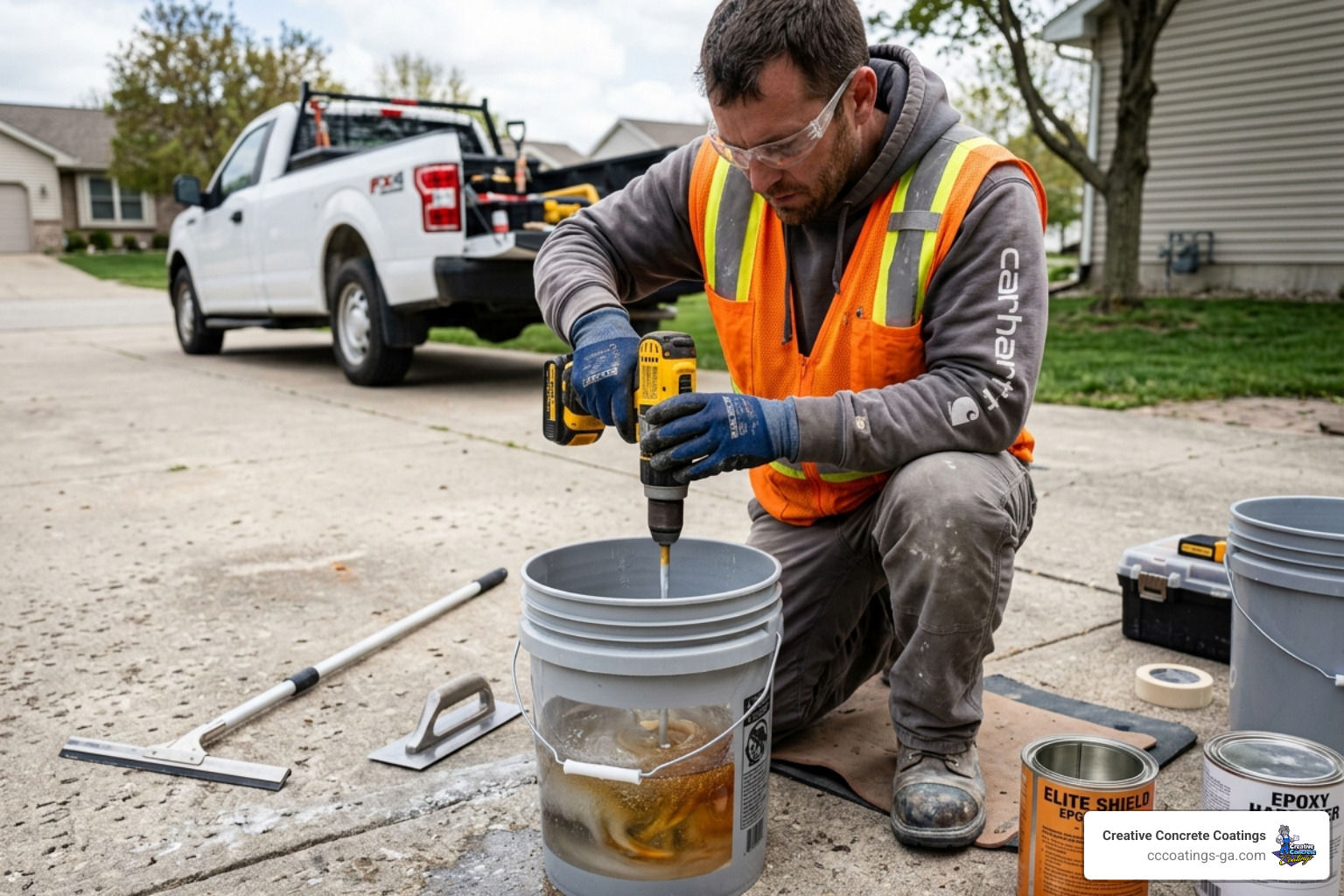
At its core, epoxy is a two-component material consisting of a resin and a polyamine hardener. When we mix these two together, a chemical reaction occurs known as an “exothermic reaction.” This isn’t just drying; it’s a molecular transformation that creates a rigid, plastic-like surface. This reaction allows the coating to achieve a massive bond strength to the concrete substrate.
Thickness and Build
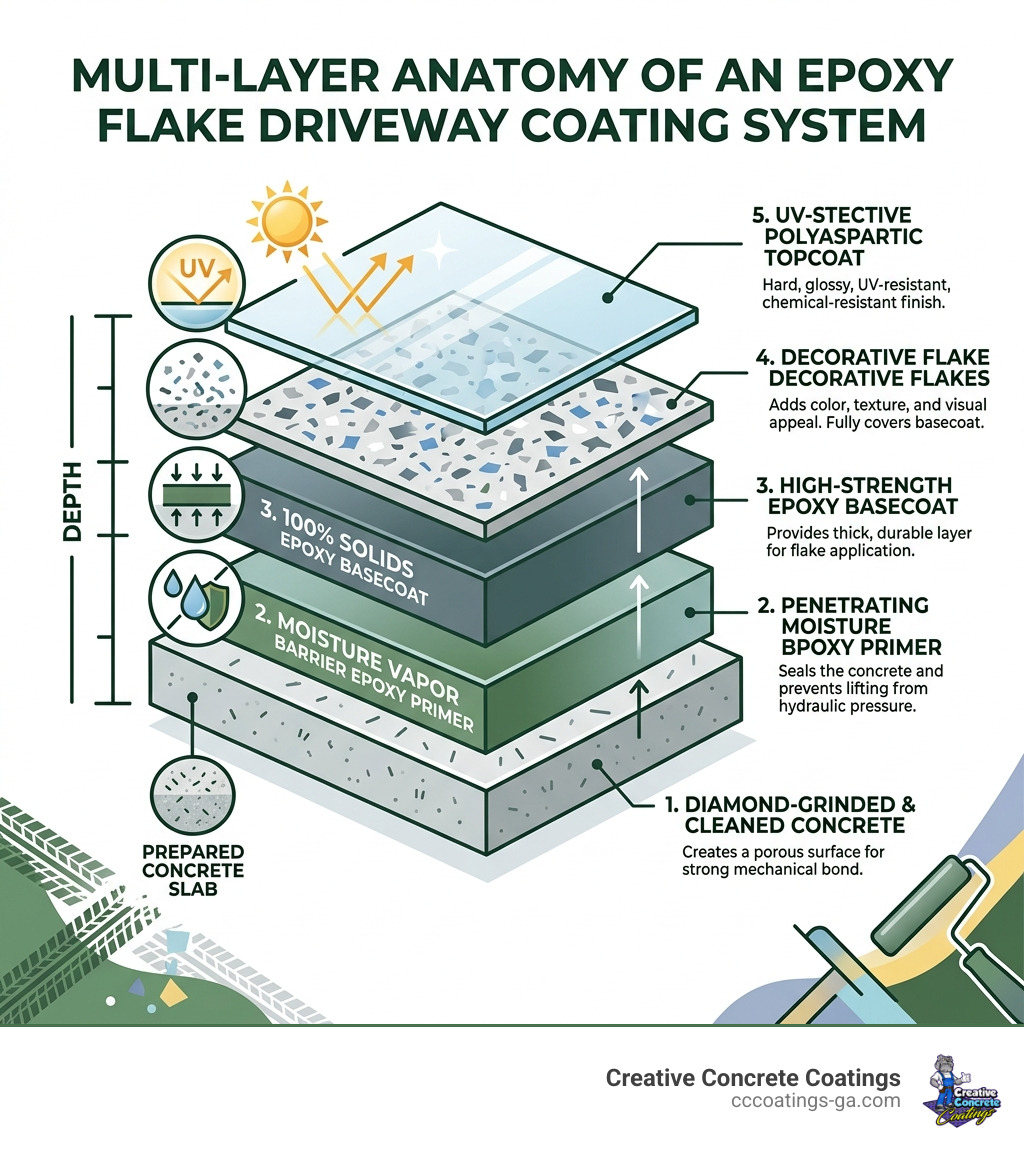
A high-quality epoxy concrete driveway system usually ranges from 1mm to 5mm in total thickness. This is achieved through a multi-layer approach:
- The Primer/Basecoat: This penetrates the pores of the concrete to create a mechanical bond.
- The Broadcast Layer: This is where the decorative flakes are added, providing both color and thickness.
- The Topcoat: A clear protective layer that seals everything in.
By creating a non-porous surface, we ensure that nothing—not oil, not salt, not even Georgia red clay—can penetrate the concrete. This industrial-strength solution turns a porous, vulnerable slab into a fortress.
Why Choose an Epoxy Flake Finish for Your Driveway?
You might be wondering why we suggest a “flake” finish rather than a solid color. Beyond looking like a high-end granite or terrazzo floor, the flakes serve a functional purpose.
Incredible Compressive Strength
Standard residential concrete usually sits around 3,000 to 4,000 psi. An epoxy polymer concrete overlay can provide a compressive strength of about 8,000 psi. That is exceptionally durable. It means your driveway can easily withstand the weight of heavy SUVs and delivery trucks without breaking a sweat.
Defeating “Hot Tire Pickup”
If you’ve ever seen a low-quality garage floor coating peel up right where the car tires sit, you’ve seen hot tire pickup. This happens when hot tires from a long drive cool down on a coating, causing the rubber to contract and pull the paint off the floor. Our professional systems are designed specifically to resist this, ensuring your epoxy concrete driveway stays attached to the ground, not your tires.
Weather and Weed Prevention
One of the biggest headaches for homeowners in Monroe or Alpharetta is dealing with weeds growing through driveway cracks. Because an epoxy system is seamless, it eliminates the “dirt joints” where seeds take root. Furthermore, when paired with a UV-stable topcoat, it becomes highly resistant to the intense Georgia sun, preventing the yellowing or “ambering” that plagues lower-quality installations.
- Impact Resistance: Handles dropped tools or heavy equipment without chipping.
- 30-Year Potential: While the topcoat may need a refresh, the underlying system can extend the concrete’s lifespan significantly.
- Slip Resistance: The texture of the flakes provides natural traction, even when wet.
The Installation Process: From Prep to Protection
At Creative Concrete Coatings, we have a saying: “A coating is only as good as the prep beneath it.” You can buy the highest-quality resin in the world, but if you put it on a dirty or poorly prepared slab, it will fail.
Mechanical Grinding: The CSP-3 Standard
We don’t just “wash” your driveway. We use heavy-duty planetary diamond grinders to remove the top layer of “laitance” (weak concrete dust) and open up the pores of the slab. Our goal is to achieve a Concrete Surface Profile (CSP) of 3, which feels roughly like 60-grit sandpaper. This ensures the epoxy has something to grab onto. Research shows that a well-prepared surface can increase adhesion strength by up to 50%.
Moisture and Repairs
Before the first drop of resin hits the ground, we conduct moisture vapor testing. If there is too much water pushing up from the soil, it can cause the epoxy to delaminate. We also use specialized epoxy fillers to bridge any cracks. Unlike standard concrete caulk, these fillers become part of the floor, preventing the cracks from reappearing through your new finish.
The Coating Steps
- Epoxy Basecoat: We apply a 100% solids epoxy basecoat that acts as the “glue.”
- Full Flake Broadcast: While the basecoat is wet, we broadcast decorative flakes until the floor is “saturated.” We don’t just sprinkle them; we cover every square inch.
- The Scrape: Once cured, we scrape off the excess flakes to ensure a uniform, smooth-yet-textured surface.
- Polyaspartic Topcoat: Finally, we apply a high-performance polyaspartic topcoat. This is the “secret sauce” that provides UV protection and chemical resistance.
Comparing Epoxy to Polyaspartic and Other Coatings
It is common to hear the terms “epoxy” and “polyaspartic” used interchangeably, but they are different tools for different jobs.
| Feature | Epoxy | Polyaspartic |
|---|---|---|
| UV Stability | Low (will yellow in sun) | High (UV stable) |
| Cure Speed | 8-24 hours per coat | 1-4 hours per coat |
| Flexibility | Rigid | More Flexible |
| Adhesion | Superior to concrete | Great (but best over epoxy) |
| Temperature | Needs 50°F+ to cure | Can be applied in freezing temps |
For an outdoor epoxy concrete driveway, we almost always use a hybrid system. We use epoxy as the basecoat because nothing bonds to concrete better. However, we use polyaspartic as the topcoat because it is 4x stronger than traditional epoxy and won’t fade or crack under the Georgia sun.
Acrylic sealers (like the ones you find at home improvement stores) are much thinner and usually only last 1-3 years. Polyurea and polyaspartic coatings offer a “return to service” time that is much faster, often allowing you to drive on the surface in just 24 to 72 hours.
Maintaining Your Epoxy Concrete Driveway for Longevity
One of the best parts of an epoxy concrete driveway is how easy it is to keep clean. You won’t need harsh acids or heavy scrubbing to keep it looking like new.
Routine Cleaning
For most days, a simple leaf blower is all you need to remove debris. If the driveway gets muddy or dusty, a soft-bristle broom and a garden hose will do the trick. For a deeper clean, use a mild, pH-neutral detergent (like Dawn dish soap) mixed with water. Avoid using “citrus-based” or “vinegar-based” cleaners, as the acid can dull the shine of the topcoat over several years.
Winter and Chemical Care
In areas like Athens or Buford, we occasionally deal with ice. While epoxy is resistant to de-icing salts, we recommend rinsing the driveway once the ice melts to prevent salt buildup. The non-porous surface also means that if your car leaks oil, you can simply wipe it up with a paper towel. No more permanent black spots on your beautiful entrance!
The Refresh
To keep your driveway looking “Hollywood-worthy” for decades, we recommend a topcoat refresh every 3 to 5 years. This is a simple process where we lightly abrade the surface and apply a fresh layer of polyaspartic. It’s like a “fountain of youth” for your driveway.
Frequently Asked Questions about Epoxy Concrete Driveways
How long does an epoxy concrete driveway take to cure?
This is the number one question we get in places like Suwanee and Lawrenceville. Generally, you can walk on the surface in about 24 hours. However, you need to wait 48 to 72 hours before parking a vehicle on it. Factors like high humidity (common in Georgia!) or cooler temperatures can extend this window slightly. We always provide a specific “ready” time based on the weather conditions during your install.
Is an epoxy concrete driveway slippery when wet?
Because epoxy creates a smooth, non-porous surface, it can be slippery if installed incorrectly. However, the “flake” system naturally provides texture. For added safety, we mix anti-slip additives—like aluminum oxide or clear glass beads—into the final topcoat. This creates a “grip” that meets or exceeds safety standards for wet surfaces, making it safe for your family to walk on even during a summer downpour.
Can epoxy be applied to any outdoor surface?
Epoxy is designed specifically for concrete substrates. It should never be applied to asphalt. Asphalt is a flexible, oil-based material that expands and contracts too much for rigid epoxy to handle—the coating would crack within weeks. For concrete, as long as the slab is structurally sound and doesn’t have major “heaving” or sinking issues, an epoxy system is a fantastic way to restore the surface.
Conclusion
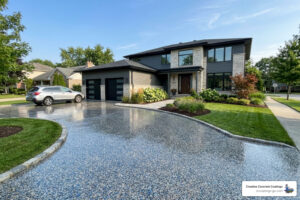
Transforming your home with an epoxy concrete driveway is more than just a cosmetic upgrade; it’s a significant enhancement to the longevity of your property. By choosing a high-quality flake system, you’re saying goodbye to cracks, weeds, and ugly oil stains, and hello to a durable, high-performance entrance that will make your neighbors green with envy.
At Creative Concrete Coatings, we bring over 25 years of experience to every project. From Monroe to Alpharetta and everywhere in between, we’ve installed over 455,000 square feet of high-performance coatings. We take pride in our “100% satisfaction” guarantee and our Marine Corps-ingrained attention to detail.
If you’re ready to stop looking at that “war zone” of a driveway and start enjoying a clean, glossy, and protected surface, we’re here to help.
Creative Concrete Coatings Monroe, GA Serving: Suwanee, Hoschton, Lawrenceville, Johns Creek, Dacula, Loganville, Alpharetta, Athens, Buford, Braselton, and Watkinsville.
Visit our website to see our work and request a consultation!