Is Your Outdoor Concrete Patio Due for an Upgrade?
Outdoor concrete patio coating is one of the smartest upgrades you can make to protect and beautify your outdoor living space. Here’s a quick look at the best options available:
| Coating Type | Lifespan | UV Resistant | Best For |
|---|---|---|---|
| Polyaspartic | 15-20 years | Yes | Patios, pool decks, walkways |
| Polyurea | 10-15 years | Yes | High-traffic outdoor surfaces |
| Epoxy | 3-5 years | No | Covered patios only |
| Acrylic Sealer | 2-3 years | Partial | Short-term residential projects |
Bottom line: For outdoor patios in Georgia’s climate, polyaspartic coatings deliver the best combination of UV resistance, durability, and longevity.
Your patio takes a beating. Sun, rain, humidity, and foot traffic slowly wear down even solid concrete. Over time, you’re left with a surface that looks tired, stains easily, and can become dangerously slippery — especially around pools or in wet conditions.
The good news? A high-quality coating doesn’t just protect your concrete. It transforms it.
Modern coating systems create a tough, non-porous shield that resists moisture, UV damage, and daily wear — while giving your outdoor space a clean, custom look that lasts for years.
I’m Scott Shannon, owner of Creative Concrete Coatings and a US Marine Corps veteran with decades of hands-on construction and coatings experience. I’ve applied outdoor concrete patio coating systems across Georgia on everything from backyard patios to commercial pool decks, and I’ve seen what works — and what fails. In this guide, I’ll walk you through everything you need to make the right choice for your space.
Why Your Backyard Needs a High-Performance Coating
Concrete is often thought of as an “indestructible” material, but here in Georgia—from Monroe to Alpharetta—it faces some serious challenges. Bare concrete is actually quite porous, much like a giant sponge. When it rains, moisture seeps into those tiny pores.
This moisture leads to a cycle of degradation. During our occasional cold snaps, that trapped water freezes and expands, causing “spalling” or surface chipping. Even when it’s warm, thermal expansion causes the slab to grow and shrink, leading to those unsightly spiderweb cracks. According to the Portland Cement Association, protecting outdoor concrete with high-quality sealers or coatings is essential for preventing long-term structural damage.
Without a professional outdoor concrete patio coating, your backyard oasis is also vulnerable to:
- UV Radiation: The intense Georgia sun breaks down the chemical bonds in bare concrete and low-quality paints, leading to dusting and fading.
- Stains: Barbecue grease, red wine, and fallen leaves can leave permanent marks on porous concrete.
- Abrasion: Dragging patio furniture or high foot traffic wears down the surface over time.
If your slab is already looking a bit rough, you might be wondering who restores old concrete patios and slabs in Monroe, GA? We specialize in exactly that. A high-performance coating doesn’t just sit on top; it bonds deeply with the concrete to create a seamless, non-porous barrier that handles freeze-thaw cycles and heavy use with ease.
Comparing Coating Technologies: Polyaspartic vs. Polyurea vs. Epoxy
Choosing the right material is the difference between a patio that looks great for twenty years and one that peels off in two. We often see homeowners get confused by the technical jargon, so let’s break down the heavy hitters in the industry.
| Feature | Polyaspartic | Polyurea | Traditional Epoxy |
|---|---|---|---|
| Durability | Ultra-High | High | Moderate |
| UV Stability | 100% (Won’t Yellow) | High | Poor (Will Yellow) |
| Flexibility | 98% More Flexible than Epoxy | Excellent | Brittle |
| Cure Time | 24 Hours (Full Traffic) | 24 Hours | 3-7 Days |
| Adhesion Strength | 1,341 PSI | High | 400-500 PSI |
When choosing the best outdoor concrete coatings for durable, beautiful patios in Monroe, GA, the chemistry matters. Most of these technologies have industrial origins; polyurea, for example, was originally developed for protecting steel bridges and truck bed liners.
Why Polyaspartic is the Gold Standard for Outdoor Concrete Patio Coating
If we had to pick a “superstar” for Georgia patios, it’s polyaspartic. Technically a type of aliphatic polyurea, polyaspartic coatings were engineered to overcome the weaknesses of older systems.
The most impressive stat? Polyaspartic coatings have an adhesion strength of 1,341 PSI. To put that in perspective, the industry standard for a “good” bond is only 400-500 PSI. This means the coating is essentially becoming part of the concrete itself.
Because it’s UV stable, it won’t turn yellow or become brittle under the sun. It also offers a 15-20 year lifespan with basic maintenance. Plus, for the busy homeowner in Suwanee or Johns Creek, the rapid curing is a game-changer. We can often complete a full installation in just one day, and you can walk on it 24 hours later.
The Limitations of Traditional Epoxy Outdoors
We love epoxy for indoor garages, but putting standard epoxy on an outdoor patio is like sending a snowman to the beach. It just isn’t built for it.
Within a year or two of direct sun exposure, epoxy begins to undergo UV degradation. It starts to “chalk,” turns a sickly yellow, and becomes brittle. Because epoxy is rigid, it can’t move with the concrete during Georgia’s temperature swings. This leads to peeling and delamination. While epoxy is a versatile material, for outdoor concrete patio coating projects, it’s best reserved for fully covered, shaded areas where the sun can’t reach it.
The Professional Installation Process for a Long-Lasting Outdoor Concrete Patio Coating
A coating is only as good as the preparation beneath it. In fact, we tell our clients that 80% of a coating’s success happens before the first drop of product is even mixed.
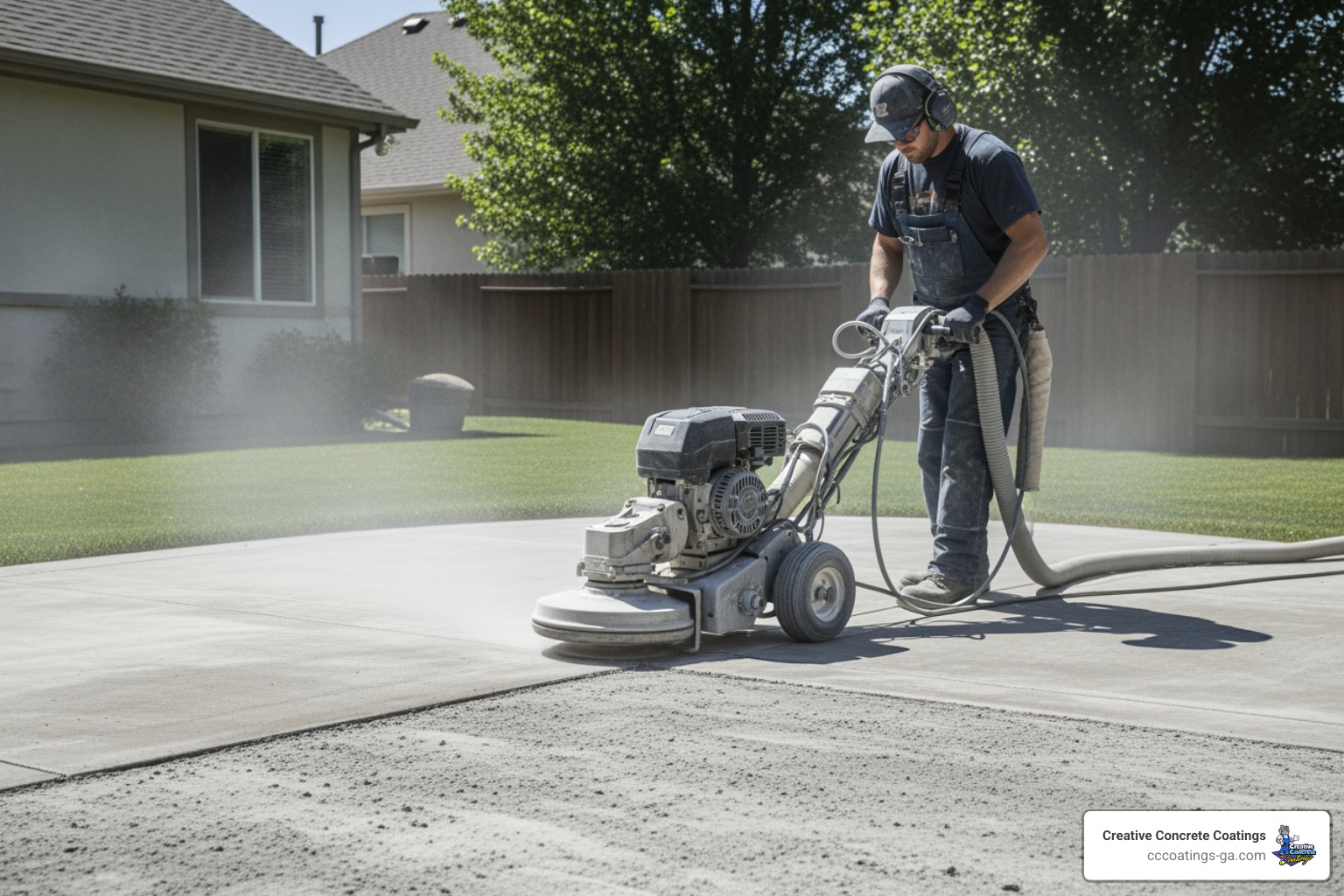
Step 1: Surface Preparation and Diamond Grinding
We don’t just “wash” the concrete. To ensure that 1,341 PSI bond, we use heavy-duty industrial diamond grinders to remove the top layer of “laitance” (weak concrete dust) and open up the pores. We aim for a profile similar to 150-grit sandpaper. This mechanical bond is what prevents the floor from peeling later. If we’re removing an old, failing coating, we follow all safety guidelines for removing old coatings to ensure no lead dust or harmful contaminants are released into your backyard.
Step 2: Crack Repair and Moisture Testing
Before the coating goes down, we address any structural issues. We use specialized menders to fill cracks and pits so the final finish is perfectly smooth. We also perform moisture vapor emission tests. If the moisture level is above 3 lbs per 1,000 sq. ft. over 24 hours, we apply a moisture mitigation layer. This prevents “osmotic blistering,” where moisture trapped under the coating tries to push its way out, creating bubbles.
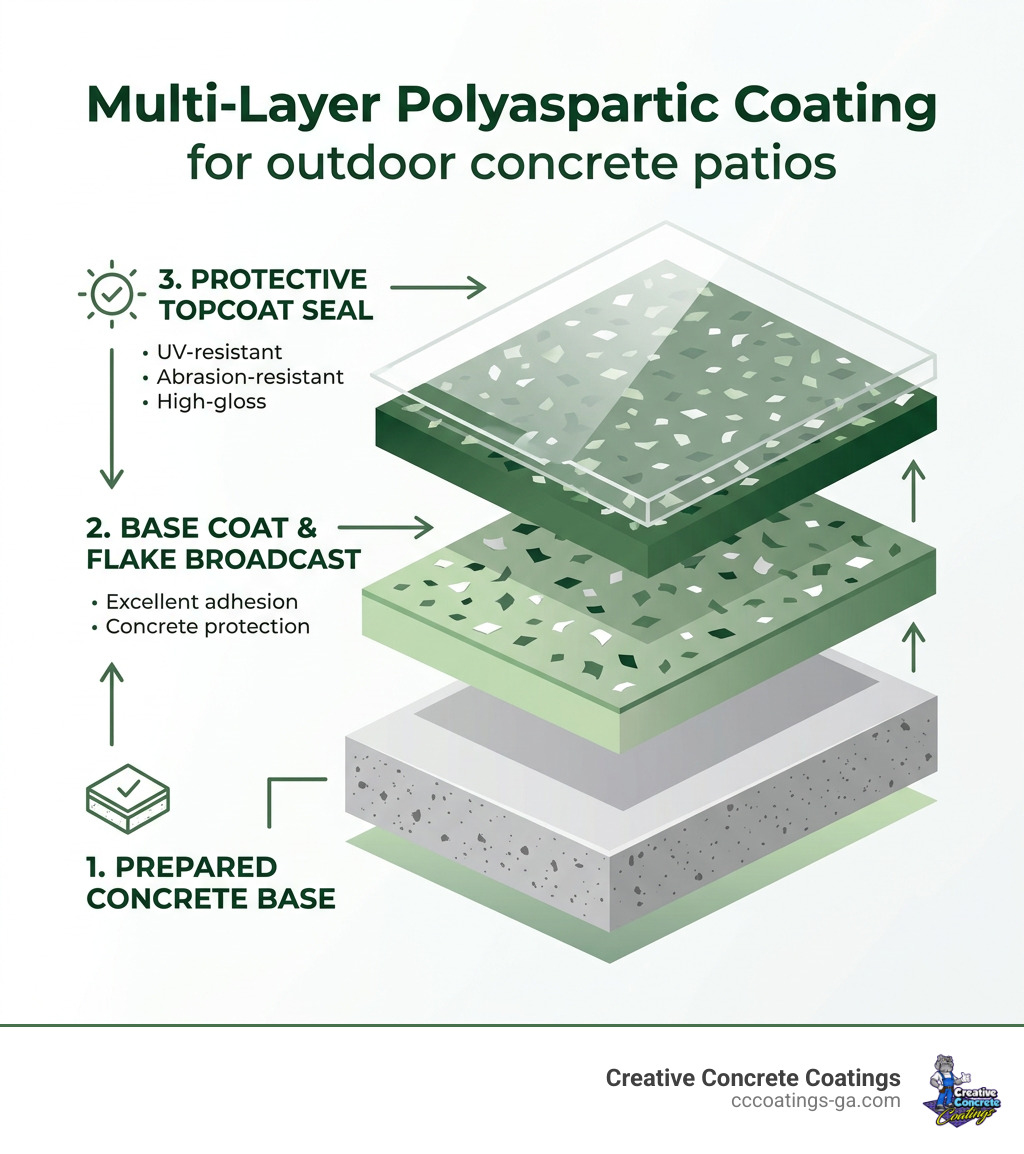
Step 3: The Multi-Layer Application
Once the floor is prepped and cleaned:
- Base Coat: We apply a 100% solids polyurea base coat that “wicks” deep into the concrete.
- Flake Broadcast: While the base is wet, we broadcast decorative vinyl flakes to excess. This provides the color and the essential slip-resistant texture.
- Scrape and Vacuum: Once cured, we scrape off the excess flakes to ensure a uniform texture.
- Top Coat Seal: We finish with a clear polyaspartic top coat. This UV-stable layer protects the flakes and provides the final “shield” against the elements.
Customizing Your Space: Flake Systems and Aesthetic Options
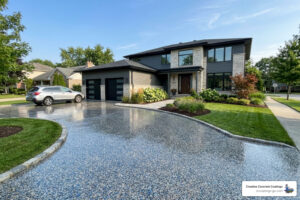
One of the best parts of a professional outdoor concrete patio coating is the ability to customize the look. You aren’t stuck with “concrete gray” anymore.
Vinyl Flakes vs. Quartz Aggregates
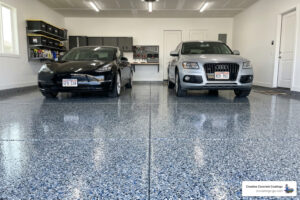
Most of our residential clients in Loganville and Buford prefer vinyl flake systems. These provide a rich, multi-colored texture that mimics the look of granite or natural stone. For areas that need even more “bite,” such as steep walkways or commercial pool surrounds, we can use quartz aggregates, which offer a slightly more industrial, high-grip finish.
Safety and Slip Resistance
Safety is a major concern, especially if you have kids or grandkids running around a pool. Bare concrete or old-school “painted” patios can be incredibly slick when wet.
We use non-slip additives like aluminum oxide in our top coats. This ensures the surface achieves a coefficient of friction (COF) well above the national standard of 0.42. In fact, our textured polyaspartic finishes often reach a COF of 0.49 to 0.59, making them safer than polished concrete even when soaking wet. If you’re looking for the best company for outdoor concrete coatings in Monroe, GA, look for a team that prioritizes this safety aspect.
Maintaining Your Outdoor Concrete Patio Coating for Decades
We want your patio to look just as good in year ten as it did on day one. Fortunately, these systems are designed to be virtually maintenance-free.
- Routine Cleaning: A simple sweep or a quick spray with a garden hose is usually all it takes to remove dirt and debris.
- Mild Detergents: For stubborn spots (like bird droppings or spilled BBQ sauce), use a mild, pH-neutral soap and a soft-bristle brush. Avoid harsh acids or ammonia-based cleaners.
- Seasonal Inspections: Every spring, give your patio a quick once-over. Check the expansion joints and ensure no heavy impact has chipped the top coat.
- Pressure Washing: While these coatings are tough enough to handle a pressure washer, you’ll find you rarely need one. The non-porous surface means dirt stays on top rather than getting ground in.
- Maintenance Coats: Every 5 to 7 years, depending on sun exposure and traffic, you can choose to apply a fresh “maintenance” top coat to keep the gloss looking brand new.
Frequently Asked Questions
How long does a professional patio coating last?
When installed correctly using polyaspartic technology, you can expect a lifespan of 15 to 20 years. We’ve seen systems last even longer with proper care. Unlike hardware store DIY kits that might last a single season, our industrial-grade materials are 4x stronger than epoxy and 98% more flexible, meaning they don’t crack or peel as the seasons change.
Can coatings be applied to cracked or old concrete?
Yes! In fact, most of our projects in places like Athens and Watkinsville involve “saving” old concrete. As long as the slab is structurally sound (not sinking or completely crumbling), we can repair the cracks and pits during our prep phase. The coating then acts as a protective skin that prevents those cracks from returning or expanding.
Is a coated patio slippery when wet?
This is a common myth. While a “smooth” epoxy or polyaspartic floor can be slippery, we specifically design our outdoor concrete patio coating systems with texture. By broadcasting vinyl flakes and adding aluminum oxide to the final seal, we create a surface that offers excellent traction, even for bare feet around a pool.
Conclusion
Your outdoor space is an extension of your home. It’s where you host summer cookouts, enjoy your morning coffee, and watch the kids play. Don’t let stained, cracked, or boring concrete take away from that experience.
At Creative Concrete Coatings, we bring over 25 years of experience and more than 455,000 square feet of installed excellence to every project. Whether you’re in Dacula, Braselton, or right here in Monroe, GA, we are dedicated to providing a 100% satisfaction-guaranteed transformation.
Ready to stop pressure washing and start enjoying your backyard? We’re ready to help you create a durable, beautiful oasis that will be the envy of the neighborhood.
Schedule a consultation for your outdoor concrete patio coating today and find out why homeowners across Georgia trust us to protect their most important surfaces. Let’s get your patio “Marine-grade” tough!