
Why Your Basement Floor Coating Choice Matters More Than You Think
The best basement floor coating protects your space from moisture, heavy use, and wear — while making it look great. Here’s a quick breakdown of the top options:
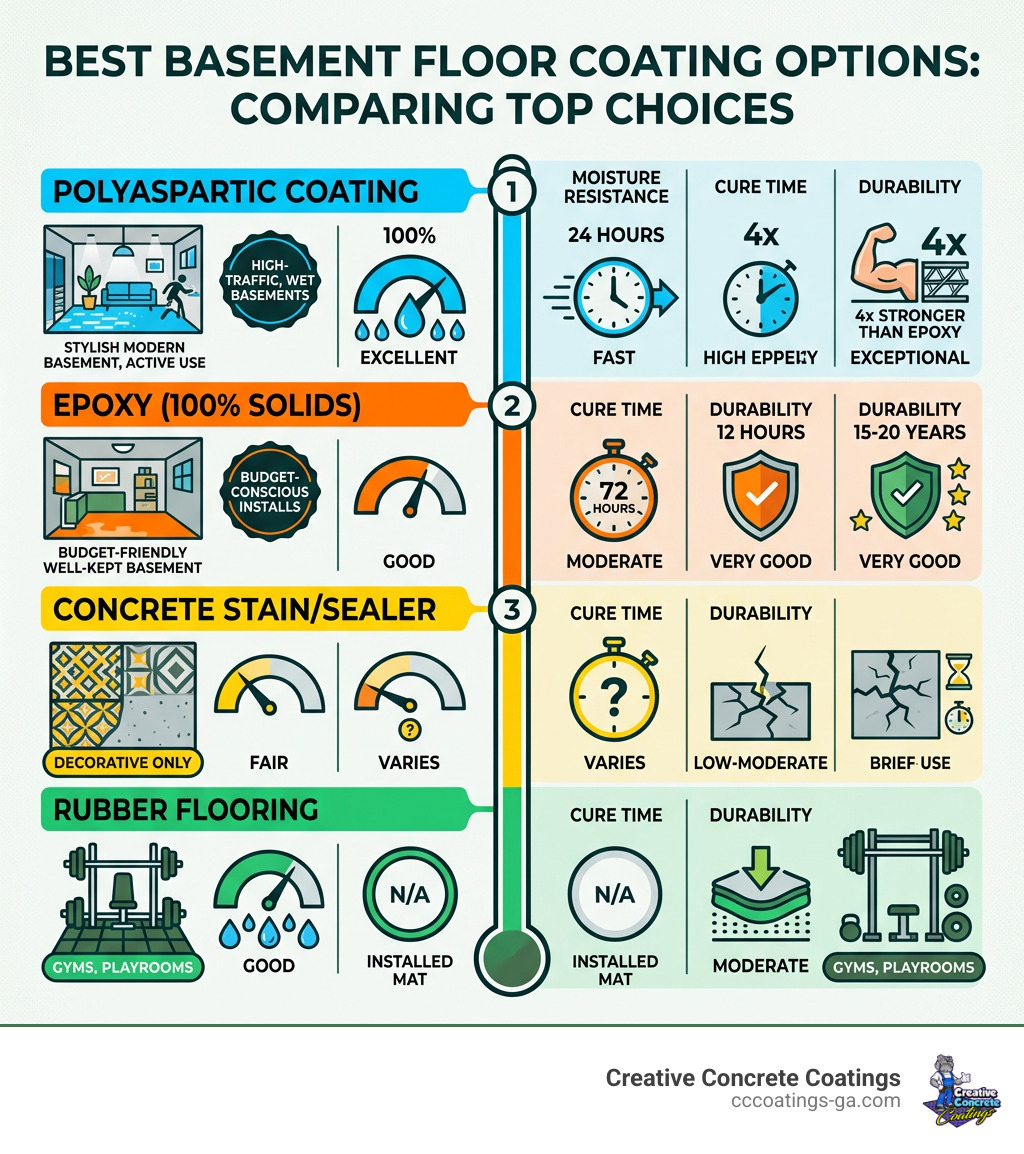
| Coating Type | Moisture Resistance | Cure Time | Durability | Best For |
|---|---|---|---|---|
| Polyaspartic | Excellent (100%) | 24 hours | 4x stronger than epoxy | High-traffic, wet basements |
| Epoxy (100% solids) | Good | 72 hours | 15-20 years | Budget-conscious installs |
| Concrete Stain/Sealer | Fair | Varies | Low-moderate | Decorative only |
| Rubber Flooring | Good | N/A | Moderate | Gyms, playrooms |
Bottom line: For most Georgia homeowners, a polyaspartic or professional epoxy system is the smartest choice for a basement floor.
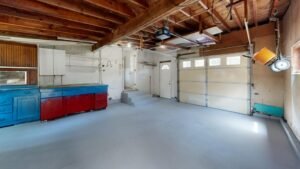
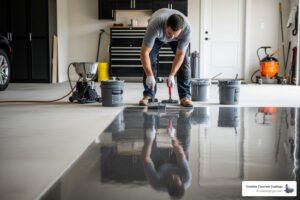
Your basement is valuable square footage. But bare concrete works against you — it’s porous, cold, and absorbs moisture like a sponge. Without the right coating, you’re looking at stains, cracks, dust, and eventually mold.
Choosing the wrong product — or skipping proper surface prep — can mean a coating that peels, bubbles, or fails within a few years. Getting it right the first time matters.
This guide breaks down every major option so you can make a confident, informed decision.
I’m Scott Shannon, owner of Creative Concrete Coatings and a U.S. Marine Corps veteran with decades of hands-on construction and coatings experience — helping homeowners across Georgia find the best basement floor coating for their specific needs. Whether you’re dealing with a damp slab or a high-traffic rec room, I’ll walk you through exactly what works.
Comparing the Best Basement Floor Coating Options for Your Home
When you start looking for the best basement floor coating, you’ll likely find yourself caught between two heavy hitters: polyaspartic and epoxy. While both beat bare concrete by a mile, they behave very differently once they hit your floor.
Basements in Georgia, from Monroe to Alpharetta, face unique challenges. Because they are below grade, they are prone to higher humidity and hydrostatic pressure (water pushing through the concrete). A coating that looks good but can’t handle moisture will eventually delaminate, leaving you with a peeling mess.
One of the most important factors to consider is how much foot traffic your basement will see. Is this a quiet storage area, or is it a high-energy home gym and game room? The level of activity dictates whether you need a standard protective layer or an industrial-strength shield.
Polyaspartic: The Best Basement Floor Coating for Durability
If you want the “gold standard” of protection, polyaspartic is the clear winner. Originally developed for industrial use in airplane hangars and hospitals, this technology—often referred to as Cyclospartic™ in its most advanced forms—is designed to take a beating.
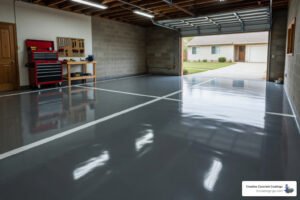
What makes it the best basement floor coating for many? First, it’s incredibly fast. While some systems leave your basement off-limits for a week, a polyaspartic coating cures in just 24 hours. It’s also four times stronger than traditional epoxy, meaning it won’t chip if you drop a heavy dumbbell or move furniture around. Plus, it is 100% water-resistant, creating an impenetrable barrier against the dampness typical of Georgia basements.
Epoxy Systems: A Reliable Best Basement Floor Coating Alternative
Don’t count epoxy out just yet. A professional-grade, 100% solids epoxy system is a tried-and-true classic. Unlike the thin, water-based paints you find at big-box stores, a 100% solids epoxy creates a thick, resilient plastic-like surface.
Epoxy is excellent at “wetting out” the concrete, meaning it flows into the pores to create a strong mechanical bond. It offers great moisture vapor tolerance, often handling 5-8 lbs of pressure per 1,000 square feet. The main trade-offs are the cure time—usually 72 hours before you can walk on it—and a slightly lower level of flexibility compared to polyaspartic. However, for a residential basement that doesn’t see “industrial” levels of abuse, a quality epoxy system can easily provide 15 to 20 years of service.
Why Polyaspartic Technology Outperforms Traditional Solutions
To understand why polyaspartic is often called the “speedy superhero” of the flooring world, you have to look at what’s happening beneath the surface.
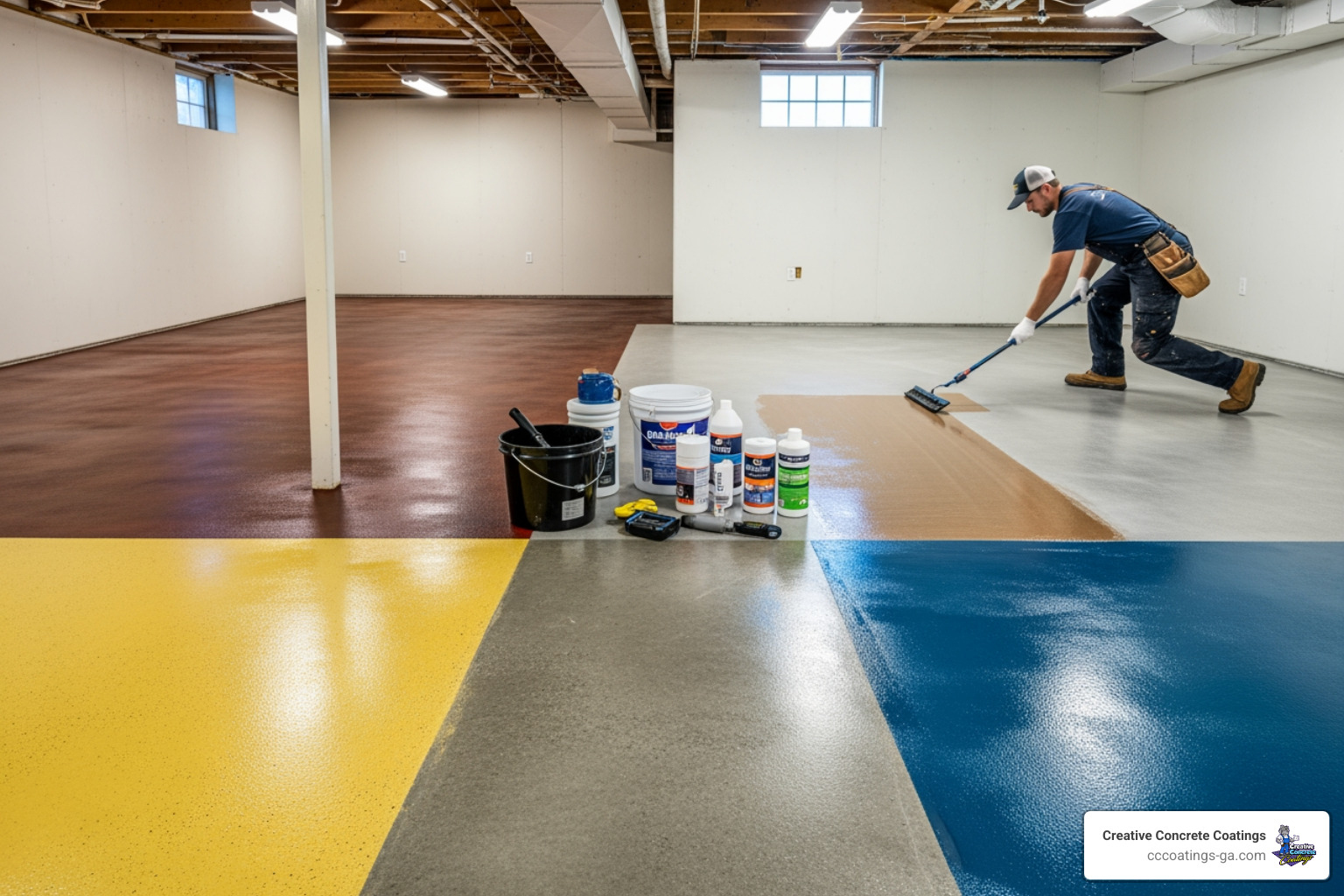
Think of your concrete floor like a giant, hard sponge. It has millions of tiny pores. Traditional epoxy is thick and sits mostly on top of those pores. Polyaspartic, however, has a unique chemical structure that allows it to penetrate deep into the concrete. This creates a root-like bond that is much harder to pull up.
Another massive advantage is flexibility. Concrete expands and contracts with the changing Georgia seasons. Because polyaspartic is an elastomer, it can move slightly with the floor. Epoxy is more rigid; if the concrete moves or cracks, the epoxy is more likely to crack with it. This flexibility is a key reason why polyaspartic is so effective at protecting your basement floor from moisture. By remaining a seamless, flexible membrane, it prevents water from finding a way through.
When you invest in a professional installation, you aren’t just getting a pretty color; you’re getting a 25-year service life. That’s a quarter-century of not having to worry about your basement floor.
The Importance of Professional Surface Preparation
If there is one thing I want every homeowner in Suwanee or Johns Creek to know, it’s this: about 80% of a coating’s success comes down to surface preparation. You could have the most expensive, high-tech polyaspartic in the world, but if the concrete isn’t prepared correctly, it will peel off like a sunburn.
Many DIY kits suggest “acid washing” the floor. In our 25+ years of experience, we’ve seen that this is rarely enough. Professional installers use industrial diamond grinders equipped with HEPA dust-collection systems. This process does two things:
- It removes the “laitance” (the weak top layer of concrete).
- It opens up the pores, creating a profile that looks and feels like 80-grit sandpaper.
This is the only way to ensure the coating actually “locks” into the floor. Beyond grinding, we also perform moisture testing to ensure the slab isn’t too wet for the product. We repair every crack and divot with high-strength fillers so the final result is perfectly smooth. This level of prep is why professional coatings last decades, while DIY epoxy often fails within the first year.
Popular Finish and Aesthetic Options for Basements
Just because a floor is durable doesn’t mean it has to look like a factory. Today’s coatings offer stunning visual variety that can make your basement feel like a high-end living room.
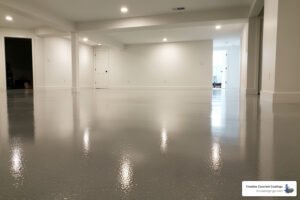
The most popular choice for Georgia basements is the Flake System. This involves broadcasting decorative vinyl chips into the wet base coat until the floor is completely covered.
- Classic Flake: A balanced mix of colors (like grays, blacks, and whites) that provides a timeless look.
- Granite Flake: Uses smaller chips to mimic the sophisticated look of natural stone.
- Sandstone: Offers warmer, earthier tones that make a space feel cozy and inviting.
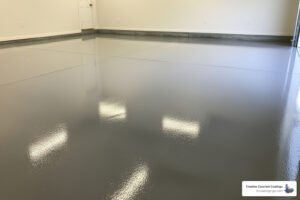
Beyond looks, these flakes provide built-in slip resistance, which is vital if your basement is prone to dampness. They are also masters of disguise—the multi-colored pattern hides dust, pet hair, and minor floor imperfections, making your maintenance routine much easier. Because the system is seamless from wall to wall, there are no grout lines or seams to trap dirt or harbor mold.
Frequently Asked Questions about Basement Floor Coatings
Can I install a basement floor coating myself?
While you can buy a kit at a home improvement store, it is rarely the best basement floor coating solution for a finished living space. DIY kits are usually water-based and much thinner than professional products. More importantly, without an industrial grinder, you can’t achieve the necessary surface profile for a permanent bond. Most DIY failures happen because the coating simply “stuck” to the surface rather than “bonding” with the concrete.
How do you clean and maintain coated basement floors?
One of the best perks of these floors is how easy they are to keep clean. Because the surface is non-porous, spills stay on top. For everyday cleaning, a simple dust mop or a quick sweep is all you need. For a deeper clean, use a pH-neutral cleaner mixed with water and a squeegee or microfiber mop. Avoid harsh chemicals or wax—they can dull the finish over time.
Can coatings be installed in basements with moisture issues?
Yes, but it requires a professional touch. We use moisture meters to check the “Moisture Vapor Transmission” (MVT) of your slab. Most quality epoxy and polyaspartic systems can handle up to 5-8 lbs of pressure. If your basement has significant standing water or major seepage, we have to address those drainage issues first. However, for typical “damp” basements, a high-quality coating is actually a great way to prevent mold and mildew by sealing off the concrete.
Conclusion
Transforming your basement starts from the ground up. Whether you are in Monroe, Loganville, or Athens, choosing the best basement floor coating is an investment in your home’s value and your family’s comfort.
At Creative Concrete Coatings, we bring over 25 years of experience and a track record of more than 455,000 square feet installed. We aren’t just contractors; we are specialists who stand behind our work with a 100% satisfaction guarantee. We know the local conditions in towns like Buford, Dacula, and Braselton, and we know exactly what it takes to make a basement floor last a lifetime.
Ready to turn that dusty concrete into a beautiful, functional space? Schedule a free estimate for the best basement floor coating today and let our team show you the Creative Concrete difference.